
Key Takeaways
- Shake in the steering wheel = front rotors. Vibration routes through the caliper → steering knuckle → tie rods → your hands
- Shake in the seat = rear rotors. Rear wheels don't connect to the steering column — it travels through the chassis
- "Warped rotor" is a misnomer. The real problem is uneven rotor thickness — microscopic high spots the pad bounces across
- Uneven rotors won't fix themselves. They wear pads unevenly and extend stopping distance every mile you drive on them
- If rotors warped again after a recent brake job, the caliper slide pins were likely seized and not serviced
Start here: front or rear?
Shake in the steering wheel
Front rotors or caliper. Front wheels connect directly to your steering — vibration routes straight to your hands.
Shake in the seat or floor
Rear rotors. No steering connection — vibration travels through the chassis instead of your hands.
Uneven Brake Rotors — Cause in 80% of Cases
Every brake application generates heat. Repeated heat-and-cool cycles cause the rotor face to develop microscopic high and low spots — this is what mechanics call a "warped" rotor, though it's rarely physically bent. The more accurate term is disc thickness variation. When the pad hits a high spot, it gets pushed back against the caliper piston. That pulse travels through the brake fluid, up through the steering knuckle, and into your hands as a rhythmic shudder that pulses in time with wheel rotation.
The highway speed test: brake from 60–65 mph and pay attention to the timing. If the steering wheel shakes rhythmically during that stop but is smooth at lower speeds, thickness variation is almost certainly the cause. Rotors that develop this faster than normal are usually on vehicles with seized caliper slides, vehicles that hit deep water with hot brakes, or vehicles with improperly torqued lug nuts. Cost: $280–$450 per axle for rotors + pads.
Rhythmic pulse in the steering wheel during braking = uneven rotors. Service this week — stopping distance is longer than it should be.Seized Caliper Slide Pins — The Cause Behind the Cause
The caliper floats on two slide pins that allow it to move as the pads apply and release. When those pins seize — dried grease, corrosion — the caliper drags the pad against the rotor between stops. That constant friction generates heat, which accelerates rotor wear and creates the thickness variation that shakes your steering wheel. The clue: shake paired with one wheel running noticeably hotter than the others after a drive, or the car pulling slightly when braking.
This is also why new rotors sometimes develop the same vibration within 15,000 miles. If the caliper slide pins weren't serviced during the brake job, the drag continues on fresh rotors. Any proper brake job includes cleaning and re-greasing the slide pins. If yours didn't, go back to the shop. See our caliper diagnosis guide for how to confirm before calling. Cost: slide pin service $80–$120; full caliper replacement $300–$500 per axle.
Shake + one hot wheel + subtle pull = seized caliper. Fix the slides with the rotors or the problem returns.Worn or Unevenly Worn Brake Pads
Thin pads have less material to dampen the rotor contact, making vibration more pronounced. Unevenly worn pads — thicker on one side than the other, usually from a seized slide — hit the rotor at an angle rather than flat, generating a vibration that pulses with wheel speed. Check through the wheel spokes: both inner and outer pads should be at least 3–4mm thick, and roughly equal. If one pad is dramatically thinner, a caliper issue is causing the uneven wear.
The combination of worn pads, uneven wear, and scored rotors is what most brake jobs are actually addressing when someone comes in with a shaking steering wheel. Rarely is it one thing alone. Shake + squealing or grinding means both pads and rotors need attention now. Cost: $280–$450 per axle for pads + rotors.
Shake + squeal or grind = pads and rotors. Service now before the score marks get deeper.Worn Wheel Bearing
A worn front bearing causes a wobble that's present while cruising — not only during brake application. That's the key difference from a rotor problem. It often comes with a hum or growl that changes pitch when you turn slightly (weight shifts off the bad bearing, changing the load and the noise). If the vibration exists at highway speed without braking and then worsens when you brake, bearing is likely in the picture alongside the rotors.
Wheel bearing failure is more serious than rotor vibration. A severely worn bearing affects steering geometry and, in extreme cases, can seize. Don't sit on it. Cost: $150–$300 per wheel.
Vibration while cruising AND when braking, with a hum that changes on turns = wheel bearing. Needs prompt attention.Worn Suspension Components
Worn ball joints, tie rod ends, or control arm bushings develop play — small amounts of looseness that allow the wheel to rock slightly under braking load. That rock shows up in the steering wheel as a wobble that's more random and less rhythmic than rotor vibration. It's often worse on rough pavement or when braking over bumps. Worn struts amplify the problem by allowing more suspension travel under braking, making a minor rotor issue feel more severe.
Suspension diagnosis requires hands-on inspection with the wheel off the ground — a mechanic physically checking for play in joints and tie rods. Not diagnosable by symptoms alone. Cost: $150–$400 depending on which component.
Tire Imbalance — Rules Out With One Test
The test: does the steering wheel shake at highway speed while cruising without braking? If yes, start with a tire balance check — imbalance causes vibration at speed regardless of braking. If no — smooth while cruising, shakes only when the pedal is pressed — tires are not the primary issue. Skip the tire shop and go straight to a brake inspection. Cost if it is tires: $20–$40 for a rebalance.
All Causes at a Glance
Frequently Asked Questions
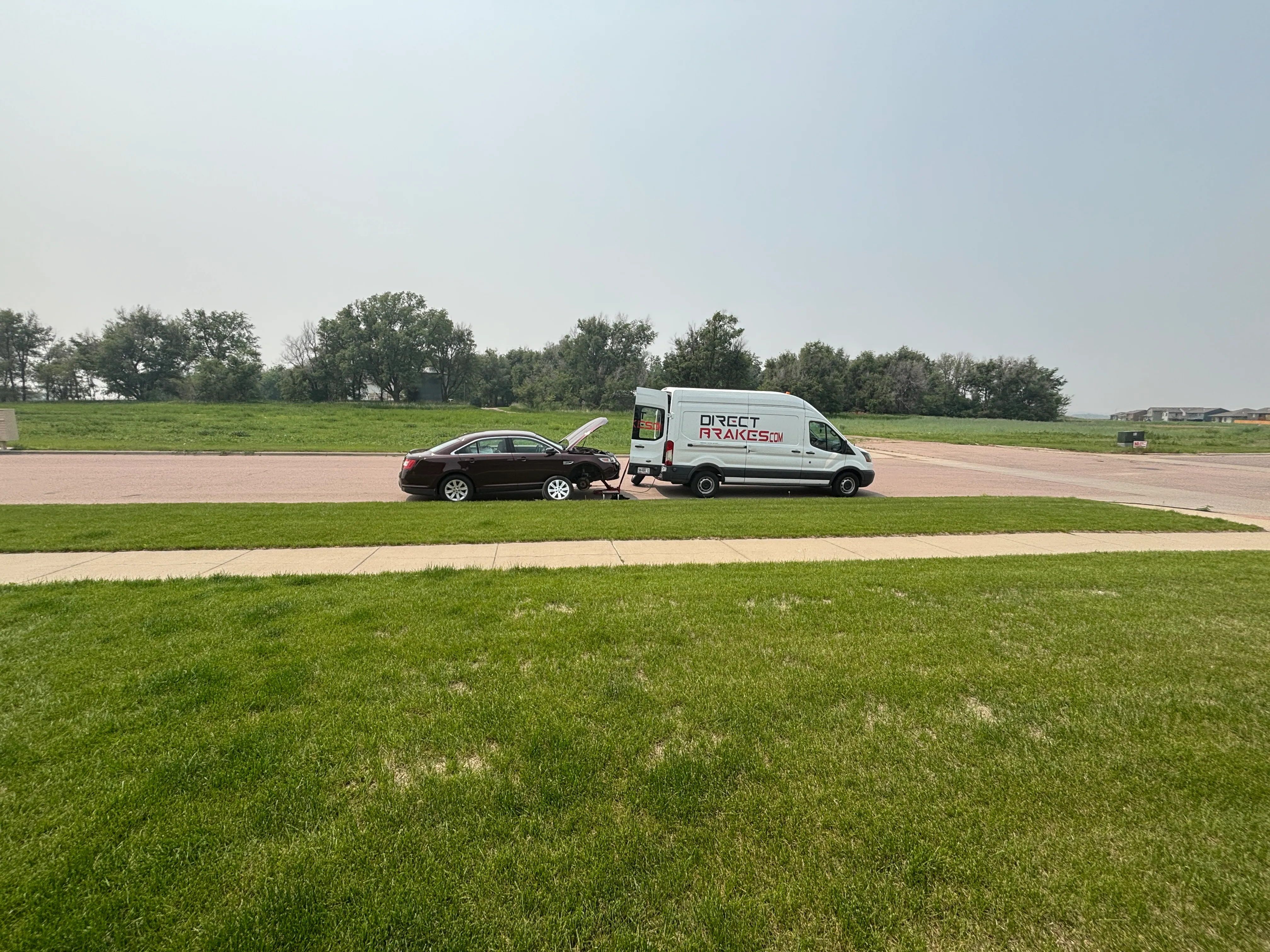
Car pulling when you brake? Call (605) 376-2130 — we'll diagnose it and fix it at your door, same day.
Steering wheel shaking when you brake?
We diagnose the cause and fix rotors, calipers, and pads at your door. Same-day in Sioux Falls and Omaha.
Get Free Quote (605) 376-2130