
Key Takeaways
- Most brake pads last 25,000–70,000 miles — the average driver replaces fronts around 40,000–50,000 miles
- Front pads wear 20–30% faster than rears — it's normal to replace fronts twice before the rears need service
- City driving can cut lifespan nearly in half compared to highway driving — it's the single biggest variable
- The squeal is your cheap warning. Ignoring it until grinding typically adds $150–$250 per axle in rotor replacement cost
- At 3mm remaining, pads need to be replaced. The wear indicator fires around 2–3mm and gives you days to weeks to act
The Real Mileage Answer: 25,000–70,000 Miles
Every source gives you the same range: 25,000–70,000 miles. That's not a very useful number on its own. Here's how to think about where your pads actually fall in that range.
The range exists because two real-world extremes both happen. A delivery driver doing constant city stop-and-go in a heavy SUV with aggressive brake habits can go through a set of pads in 20,000 miles. A commuter who mostly drives highway miles in a compact sedan with smooth habits can get 70,000 miles out of the same pads. Most people fall somewhere in the middle — 40,000–50,000 miles on the fronts, 60,000–70,000 miles on the rears, is a reasonable baseline for an average suburban/highway mix.
The five factors that determine where you land in that range are covered below. After reading them you'll have a much clearer sense of whether your next brake job is due at 30,000 miles or 60,000.
Front vs. Rear Pads: Why Fronts Always Wear First
This is the most overlooked part of brake pad lifespan — and it's why people are often surprised that their front pads need replacing when the rears still look fine. Front brakes handle approximately 60–70% of all stopping force on a typical vehicle. Physics is the reason: when you apply the brakes, inertia transfers the vehicle's weight forward and loads the front axle. The front tires dig in harder, and the front brakes work harder to match.
The practical consequence: if your front pads last 40,000 miles, expect your rear pads to last 55,000–65,000 miles. Replacing fronts twice before the rears need service is completely normal and expected — not a sign that something is wrong. Rear-wheel-drive vehicles and all-wheel-drive vehicles with significant rear braking bias may see this gap shrink somewhat, but the front-first pattern applies to the vast majority of passenger vehicles.
This also means: never try to stretch a front brake job because the rears still look good. They're not the same job. When you get a brake inspection, the front and rear wear numbers will be quoted separately for exactly this reason.
Always inspect front and rear independently — wear rates are differentBrake Pad Type: Organic vs. Semi-Metallic vs. Ceramic
The material your brake pads are made from is the second-biggest factor in lifespan after driving habits. There are three types, each with meaningfully different durability profiles.
Organic (NAO) Pads — 25,000–40,000 miles
Made from a blend of rubber, carbon, glass fiber, and resins. The softest compound of the three — and the quietest. Organic pads generate less rotor wear, are easy on rotors, and are the cheapest to manufacture. The downside: they wear faster than metallic or ceramic options, produce more brake dust, and fade under high heat. Most common on economy vehicles and as OEM equipment in markets that prioritize quiet operation. Fine for light daily use; not the right choice for mountain driving, towing, or aggressive driving.
Semi-Metallic Pads — 40,000–60,000 miles
30–70% metal content (steel, copper, iron, graphite). The most common type on the road today and the default OEM choice for most trucks, SUVs, and performance-oriented vehicles. Better heat dissipation than organic pads — they handle sustained heavy braking without fading. More durable overall, but slightly harder on rotors than ceramic. Can squeal more in cold weather. If you drive a truck, tow regularly, or do a lot of highway driving, you're likely on semi-metallic pads and for good reason.
Ceramic Pads — 50,000–70,000 miles
Dense ceramic compound with copper fiber reinforcement. The longest-lasting and cleanest of the three — minimal brake dust, quietest operation, consistent friction across a wide temperature range. Ceramic pads run cooler than metallic pads at moderate heat levels, which is why they last longer under normal daily driving conditions. They're not always the right choice for heavy towing or performance driving (where semi-metallic's higher heat tolerance wins), but for everyday commuter use in sedans, crossovers, and light SUVs, ceramic is the longevity choice.
Most vehicles on the road today use semi-metallic or ceramic pads from the factory. If you're unsure what type you have, ask when you book your next brake inspection.
Driving Habits: The Biggest Variable
Pad type and vehicle weight are set at purchase. Your driving habits are under your control — and they have the largest single effect on how often you're replacing pads.
City driving vs. highway driving
This is the starkest comparison. A commuter who drives 40 miles each way on the highway might brake a handful of times per trip — highway on-ramps, the occasional slow traffic, the exit. A city driver doing the same 40 miles might brake 80–100 times. City driving can reduce brake pad life by 40–50% compared to an equivalent highway mileage. It's not just frequency — it's also the repeated heating and cooling cycles from constant light stops that accelerate pad compound breakdown.
Hard braking from high speed
The physics: stopping from 60 mph requires four times the energy as stopping from 30 mph (kinetic energy scales with the square of velocity). A driver who habitually brakes hard from highway speed will wear pads two to three times faster than a driver who coasts and brakes gradually to the same speeds. A single emergency stop from 70 mph generates enough heat to cause minor glazing of the pad surface.
Riding the brakes
Keeping your foot lightly on the brake pedal — especially on long descents — keeps the pads in partial contact with the rotors continuously. That constant low-level friction generates heat that builds over time, accelerating wear and potentially glazing both the pads and rotors. On a long mountain descent, this can wear as much pad material as 1,000–2,000 miles of normal driving.
Tailgating
Driving too close to the car ahead forces reactive braking — harder stops from higher speeds with less notice. Drivers who maintain a 3–4 second following distance can coast and brake smoothly. Tailgaters brake reactively and hard, every time. Over 50,000 miles of driving the difference in pad wear between these two habits is substantial — potentially a full extra brake job.
Smooth, anticipatory braking is the single most effective way to extend pad lifeVehicle Weight and Type
Brakes convert kinetic energy to heat. More mass = more kinetic energy = more heat generated per stop = faster pad wear. A full-size pickup truck or heavy SUV weighing 5,500–6,500 lbs will wear through brake pads measurably faster than a 3,000 lb compact sedan stopping from the same speeds with the same frequency.
Towing amplifies this significantly. A truck towing 8,000 lbs has roughly three times the stopping energy to manage compared to its base weight alone. If you tow regularly, expect front pads to need replacement 30–40% sooner than a non-towing baseline. Truck and SUV owners who tow frequently should budget for brake inspections at every oil change rather than every 12,000 miles.
The reverse is also true: lighter vehicles are inherently easier on brakes. A compact hatchback or sedan can realistically see 60,000+ miles on ceramic pads even with some city driving mixed in. If you drive a small car with a mostly highway commute, you're at the long end of the range.
Truck/SUV/towing owners: inspect brakes every oil change, not every yearHow to Know When Your Pads Are Due
You don't need a mileage countdown. Your brake pads communicate their condition clearly — if you know what to listen and look for.
The wear indicator squeal
The most reliable signal. A built-in steel tab contacts the rotor and produces a sharp, high-pitched squeal specifically when pads reach their minimum safe thickness — typically 2–3mm of friction material remaining. This squeal is intentionally designed to be annoying. It fires when you press the brake pedal. At that point, you have days to a couple of weeks before you're at metal-on-metal contact. Don't push it. See our brake squeaking guide for every cause including ones that aren't the wear indicator.
Visual inspection
Look through the wheel spokes at the caliper. You can see the outer brake pad pressed against the rotor face. At 3mm or less of visible friction material, it's time. A new pad is typically 10–12mm. Most brake shops quote a replacement recommendation at 4mm; the wear indicator fires at 2–3mm; metal contact starts at 1–2mm. Never let it reach metal contact if you can avoid it.
The grinding stage (too late)
If you've reached grinding — a harsh, metallic sound every time you brake — the friction material is gone and the metal backing plate is scoring the rotor. The pad replacement job just became a pad-plus-rotor replacement job. Every stop is adding rotor damage. Get it same-day. See our full brake warning signs guide for the complete urgency breakdown.
Dashboard brake warning light
Vehicles with electronic wear sensors (increasingly common on new cars, standard on most European brands) will illuminate the brake warning light when the pad sensor wears through. On these vehicles the light is your wear indicator — treat it the same way you'd treat a squeal: service within the week.
3mm or less = replace now · Grinding = same-day serviceHow to Make Brake Pads Last Longer
You can't change your vehicle's weight or the pad compound it came with without spending money. But driving habits are free to change, and they have a larger effect on brake life than any other variable.
Increase following distance
The most impactful single change. A 3–4 second following distance gives you enough warning to coast down speed before braking — reducing both braking frequency and the force required at each stop. Reactive braking from tailgating is the number-one brake-wear culprit for most drivers. This habit change costs nothing and makes the biggest difference.
Brake earlier, brake lighter
Anticipate stops and start coasting earlier. When you do brake, apply moderate consistent pressure rather than waiting until you must brake hard. Gradual deceleration uses the engine and drivetrain to absorb some kinetic energy before the brakes do the final work. Hard stops from higher speeds are the most brake-intensive braking scenario — avoid them whenever you can.
Use engine braking on descents
On long downhill stretches, shift to a lower gear (automatic or manual) and let the drivetrain provide resistance. This is especially effective in mountainous terrain where extended braking on a single descent can generate as much pad wear as hundreds of miles of normal driving. Engine braking costs nothing, saves the brakes, and keeps the rotors from overheating.
Remove unnecessary weight
Every 100 lbs of extra weight your vehicle carries translates to slightly more stopping energy the brakes must absorb per stop. A trunk full of equipment, a roof rack you never use, a full toolbox in the bed — these add up. It's a minor effect for everyday driving but measurable for high-mileage drivers or those who tow regularly.
Don't ride the brakes
Keep your left foot off the brake pedal entirely. Even light resting contact keeps the pads in partial friction contact with the rotors. On a flat highway stretch this generates constant low-level heat that can glaze pads over time and accelerates wear without providing meaningful slowing. Left foot goes on the floor, not the pedal.
Address mechanical issues early
A stuck caliper, seized slide pin, or stuck pad in the bracket will wear one pad dramatically faster than the others — often half the normal lifespan. If you're replacing pads unusually early, or if one corner is wearing noticeably faster than the other three, the cause is almost always mechanical. Fixing it during the pad replacement costs much less than the next prematurely worn set. See our caliper inspection guide.
Consistent smooth habits + early mechanical fixes = maximum pad lifeThe cost of waiting: squeal vs. grinding
Brake Pad Lifespan at a Glance
When to schedule your next brake inspection
For most drivers: with every other oil change (roughly every 10,000–15,000 miles) or whenever you hear squealing. For trucks, SUVs, or frequent towers: every oil change. For new-to-you used vehicles: immediately — you have no history on the previous owner's brake habits or current pad thickness.
Frequently Asked Questions
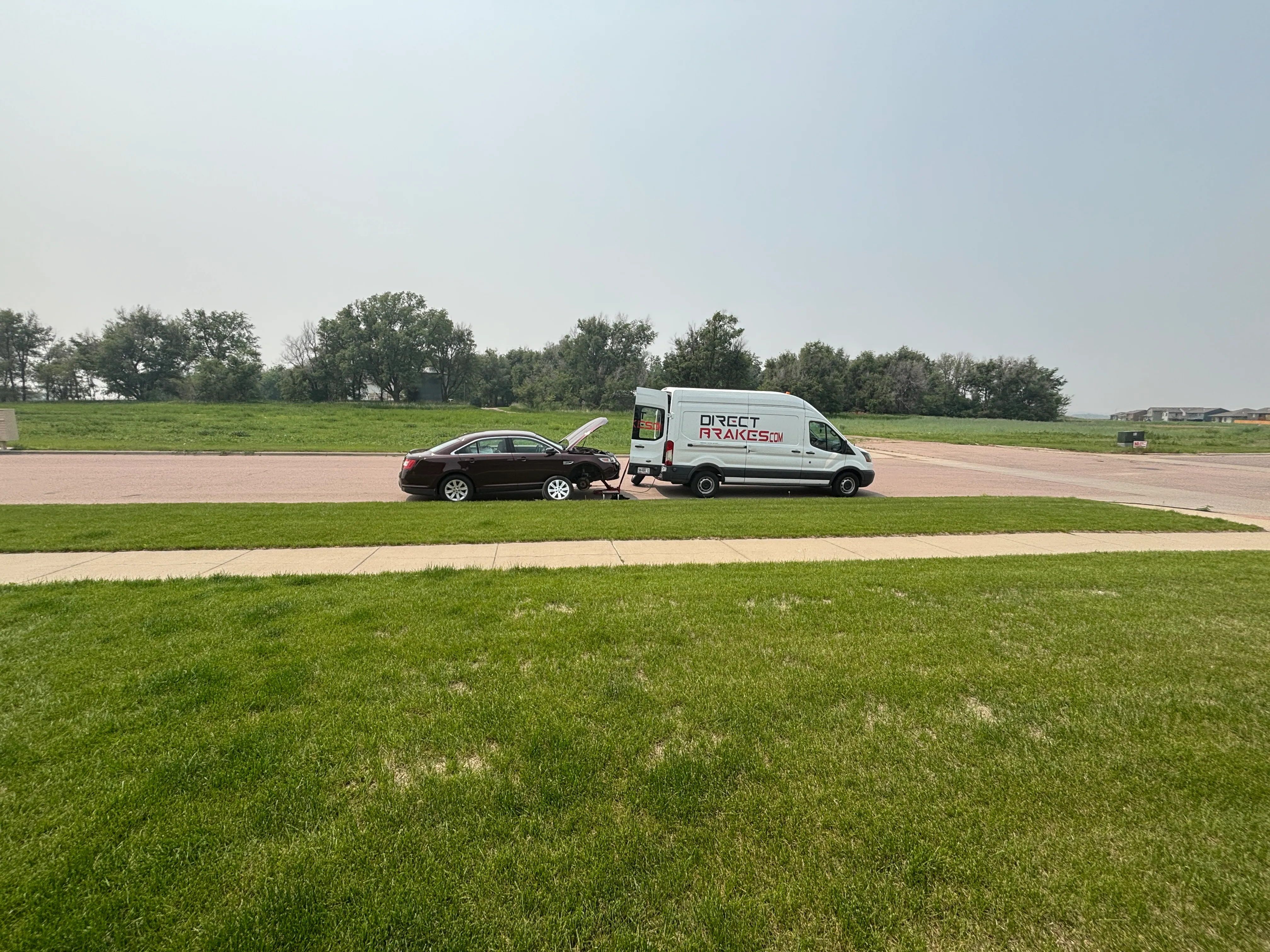
Car pulling when you brake? Call (605) 376-2130 — we'll diagnose it and fix it at your door, same day.
Due for a brake inspection?
We check pad thickness and report back at your door. Same-day appointments in Sioux Falls and Omaha.
Get Free Quote (605) 376-2130