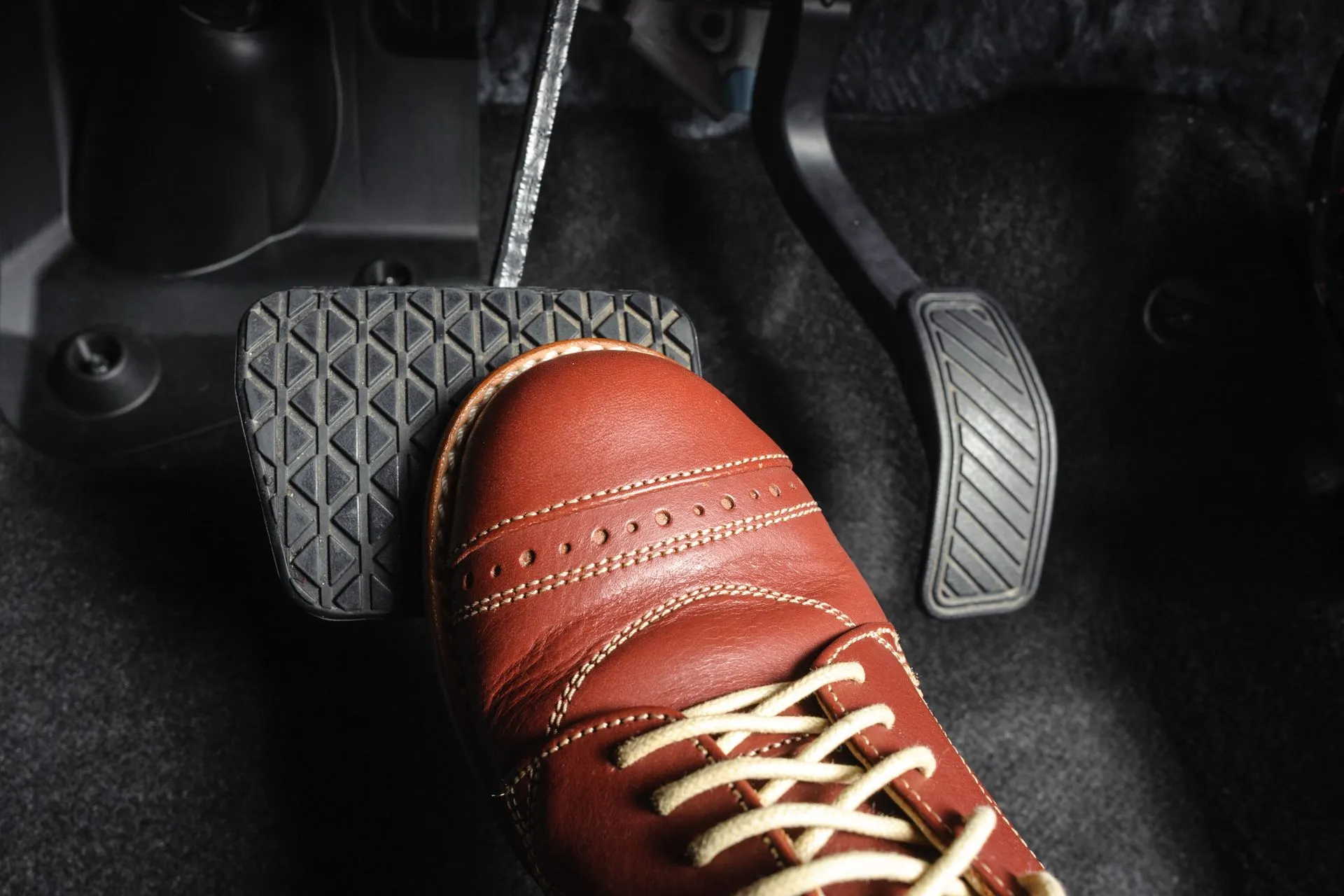
You push your foot down on the brake pedal — and instead of stopping firmly, it keeps going. All the way down. Maybe it touches the floor mat. Maybe it almost gets there but feels mushy and soft, like pressing on a wet sponge.

That feeling is terrifying. And it should be — because it means your brakes are not working the way they are supposed to.

The good news: this always has a reason. And once you know the reason, you know exactly what to do. This guide explains every cause in plain, simple language. No mechanic jargon. No confusing parts names. Just clear answers so you know what's going on and what to do next.

How Serious Is It? — At a Glance

Not every soft pedal is a full emergency — but none of them are okay to ignore. Here's a quick look at how serious each cause is:

Danger Level by Cause
Critical
Brake fluid leak — active
Fluid is escaping right now. Every mile you drive makes it worse. Do not drive.
Urgent
Failing master cylinder
Brake pressure is leaking internally. Will get worse without warning. Book today.
Urgent
Air in the brake lines
Brakes work but are not reliable. Can feel okay then fail suddenly.
Soon
Failed brake booster
Brakes still work but require much more foot pressure. Tiring and unsafe long-term.
Soon
Worn brake pads — fully gone
Metal is grinding metal. Pedal travels far before anything grabs. Book this week.

First — Here's How Brakes Work (in 30 Seconds)

Your brakes run on fluid. When you press the pedal, it pushes brake fluid through lines that run to every wheel. That fluid pressure is what squeezes the brake pads against a spinning disc and slows the car down.

The reason this works so well is that liquid cannot be compressed. When you push on one end, the pressure shows up instantly at the other end — no delay, no squishing. That's why a healthy pedal feels solid and firm.

When the pedal goes to the floor instead, one of three things went wrong: the fluid leaked out and there's not enough left to build pressure, air got into the lines and is absorbing your foot effort instead of transmitting it, or the pump that creates the pressure has worn out internally. All three feel similar from your seat — the sections below help you figure out which one it is.

The 5 Reasons Your Brake Pedal Goes to the Floor

01
Brake Fluid Leak
Do Not Drive

This is the most common reason. Brake fluid is leaking out of your system somewhere — from a cracked line, a worn caliper seal, or a loose fitting. When enough fluid escapes, there is not enough left in the system to build pressure. You press the pedal and it sinks because there's nothing there to push against.

How to spot it: Look under your car after it has sat parked for a while. Brake fluid is light yellow and oily — similar to vegetable oil. You might also see a wet spot behind one of the wheels. Another quick check: pop the hood and look at the small plastic reservoir near the back of the engine bay. It should sit between the MIN and MAX lines. If it's low or empty, you have a leak somewhere.

Feel
Pedal goes straight to the floor — no resistance at all
Signs
Puddle under car, low fluid reservoir, wet spot behind wheel
Urgency
Stop driving — call for service
Cost
$150–$320 depending on where the leak is
02
Air Trapped in the Brake Lines
Urgent

Remember — brake fluid cannot be squished. But air can. When air sneaks into your brake lines (it can happen after brake repairs, after a fluid leak, or when the system gets very low), pressing the pedal squishes the air bubble instead of pushing the brakes. The result: a soft, spongy, or mushy feeling pedal that doesn't stop well.

Here's the key difference: brake fluid cannot be compressed, but air can. So when air is in the line, pressing the pedal compresses that air pocket instead of pushing the brake pads. Your foot effort gets wasted on squeezing air rather than stopping the car. The pedal feels soft or springy — it moves but the brakes don't respond like they should.

The fix is called "bleeding" the brakes — a mechanic opens a small valve at each wheel and lets the trapped air escape until only clean fluid remains. After that, your pedal should feel firm again. This is also one of the reasons your pedal might feel soft right after brake work — air can sneak in during the repair process.

Feel
Spongy, springy, or soft — pedal moves but brakes barely respond
Clue
Often worse after recent brake work or if fluid has been low
Urgency
Book today — unpredictable stopping
Cost
$80–$150 to bleed all four wheels
03
Failing Master Cylinder
Urgent

The master cylinder is the pump that creates brake pressure when you press the pedal. Inside it are small rubber seals that keep the pressure from escaping. Over time, those seals wear out. When they fail, fluid leaks past them inside the cylinder — you never see a puddle outside the car, but the pressure goes nowhere.

The dead giveaway: the pedal slowly sinks while you hold it. You press the brake at a stop sign, it holds for a second, then quietly keeps drifting toward the floor even though you haven't moved your foot. That gradual drop under steady pressure is the master cylinder's signature failure. It's different from a fluid line leak because the fluid level in the reservoir can still look completely normal — nothing is leaking outside the car.

Feel
Pedal holds then slowly sinks under steady pressure
Clue
No visible fluid leak but pedal still feels soft or dropping
Urgency
Book today — can fail completely without warning
Cost
$200–$450 including labor and brake system bleed
04
Failed Brake Booster
Schedule This Week

Your car has a device called a brake booster that uses engine suction to make the brake pedal much easier to press. Without it, you'd need to push really, really hard on the pedal to stop the car. When the booster fails, all that help goes away.

Your car has a brake booster — a device that uses engine vacuum to multiply the force of your foot on the pedal. It's the reason you can stop a two-ton vehicle with one leg and barely any effort. When the booster fails, all that assistance disappears. The brakes still technically work, but now you have to press the pedal with much more force — and it may feel like the pedal has no resistance or firmness to it.

The clearest sign of a bad booster: the pedal feels different depending on whether the engine is on or off. Firm with the engine off, but soft or heavy to press with the engine running. That's because the booster uses vacuum from the running engine — when the engine is on, the faulty booster is actively making things worse.

Feel
Pedal very hard to press, or sinks only with engine running
Clue
Problem is worse or different with engine on vs. off
Urgency
Schedule this week — unsafe long-term
Cost
$250–$550 depending on vehicle
05
Brake Pads Completely Worn Out
Schedule This Week

Brake pads are the part that actually grabs the spinning metal disc to stop your car. They start out about as thick as a pencil eraser. Over time they wear down. When they're almost completely gone, the pedal has to travel much further before anything grabs — which can feel like the pedal is going to the floor before the car actually slows down.

Brake pads wear down over time — that's normal. But when they get down to almost nothing, the caliper piston has to extend much further out to make contact with the rotor. That extra travel means the pedal goes further down before the brakes actually bite. It's not a fluid or pressure problem — there's just not enough pad material left for the brakes to grab quickly.

If you also hear a grinding or squealing noise when you brake, that confirms the pads are nearly gone or fully worn through. You can read more about exactly how long you can drive on worn brake pads — but waiting longer only drives the repair cost higher as the metal backing plate starts chewing into the rotor.

Feel
Pedal travels far before brakes grab — delayed stopping
Sounds
Often accompanied by grinding or squealing noise
Urgency
Schedule this week — rotor damage adds cost daily
Cost
$90–$320/axle depending on damage level

The Pump Test — Figure Out What's Wrong at Home

Before you call anyone, try this simple test. It takes 60 seconds and can tell you a lot about what's causing your soft pedal.

DIY Diagnosis
The Brake Pedal Pump Test
1.
With the car parked and engine off, press the brake pedal slowly several times. Count to yourself — 1, 2, 3, 4, 5.
2.
On the last press, hold the pedal down and count to 30. Don't let up.
3.
Now start the engine while still holding the pedal.
4.
Watch what happens to the pedal over the next 30 seconds.
Pedal drops slightly when you start the engine, then stays firm: This is normal. The booster working correctly will cause a slight drop when the engine kicks in. Your booster is fine.
Pedal slowly sinks toward the floor while you hold it: Master cylinder is failing. The pressure is leaking internally past worn seals.
Pedal feels hard when engine is off, but goes soft when you start it: Brake booster failure. The booster is making things worse when the engine runs.
Pedal pumps up firm but goes soft again after sitting: Internal master cylinder leak or a slow fluid leak somewhere in the system.

If It Happens While You're Driving — Do This

This is the scary one. You're moving down the road. You press the brake. The pedal goes to the floor. Stay calm — here's exactly what to do, step by step.

Emergency Steps — Brake Pedal Failure While Driving
1
Stay calm and keep both hands on the wheel
You still have control of the car. Panicking makes everything worse. Look ahead and find a safe place to slow down.
2
Pump the brake pedal fast — up and down, rapidly
Press and release quickly, over and over. This can sometimes build up enough pressure to slow you down, especially if air in the lines is the problem. You might feel the pedal get firmer after a few pumps.
3
Take your foot off the gas and downshift
Remove your foot from the accelerator. If you drive an automatic, shift to a lower gear (3, 2, or L). If manual, downshift. The engine will help slow the car down even without using the brakes.
4
Use the parking brake — but gently and slowly
If you're still moving too fast, slowly and steadily apply the parking brake. Do not yank it all at once — that can lock the rear wheels and spin the car. Pull it up slowly and hold.
5
Steer to safety — parking lot, side street, shoulder
Use a gentle downhill slope if available. Aim for a safe flat spot. Turn on your hazard lights so other drivers know something is wrong.
6
Once stopped — the car does not move again
Leave it where it is. Call for a tow or mobile brake service. Do not try to drive it home, even if it's close. The problem that caused this will happen again.
Can pumping the brakes save you?

Pumping works sometimes — if air in the lines is the cause, rapid pumping can temporarily build pressure and slow you down. It will not work if the master cylinder has completely failed or if all the brake fluid has leaked out. Either way, it is only an emergency workaround, not a fix. Get the car serviced before driving again.

Brake Pedal Soft But No Visible Leak — What's Going On?

This is one of the most common questions people ask: "My brake pedal is soft but I don't see any fluid under the car. What's wrong?"

Here's the answer: leaks don't always show up on the ground. The master cylinder can fail completely inside without a single drop escaping outside. The seals inside it wear out, fluid slips past them internally, and the pressure disappears — all while the fluid reservoir under the hood still looks normal.

A few other causes of a soft pedal with no visible leak:

Old brake fluid that has absorbed water. Brake fluid sucks up moisture from the air over time. Wet brake fluid boils at a lower temperature, and boiling fluid turns into steam — which is compressible, just like air. This makes the pedal feel spongy. It won't leave a puddle anywhere.

A leaking caliper seal that only leaks under pressure. Some caliper seals are fine when the car sits parked but weep fluid when pressure is applied. You might never see a puddle because the fluid only escapes while you're driving, then evaporates. A mechanic checking the caliper for wetness right after a drive can usually catch this.

Quick Check You Can Do Right Now

Pop the hood. Find the small plastic container near the back of the engine — it usually has a picture of brake pads or waves on the cap. Check the fluid level against the MIN and MAX marks on the side. If it's below MIN, you almost certainly have a leak somewhere, even if you can't see it. Top it off temporarily and call for a brake inspection — don't just refill and ignore it. Low fluid means something went somewhere.

Pedal Feeling Off? We Come to You.

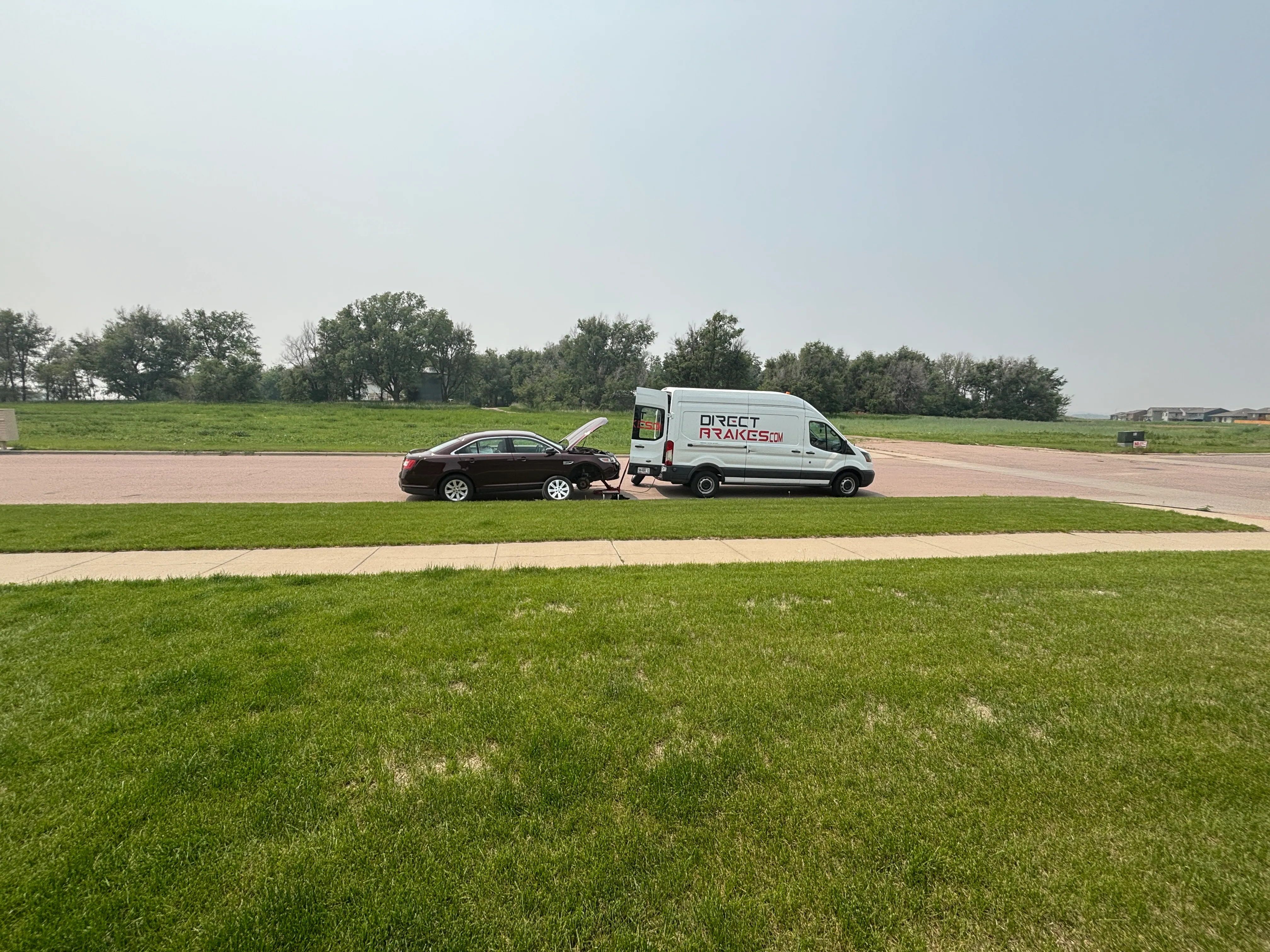
Don't wait for it to get worse. Direct Brakes diagnoses and fixes brake issues at your driveway in Sioux Falls, Brandon, Tea, and Harrisburg. Free quote, written estimate, 12-month warranty.

What Does It Cost to Fix?

Here's an honest breakdown of what each repair costs at a mobile brake service versus a shop. Mobile is almost always cheaper because there's no shop overhead — and you don't have to leave your car anywhere.

Repair costs — Mobile vs. Shop (all prices per axle or per job)
Repair Needed Mobile Cost Shop Cost Urgency
Brake system bleed (air removal) All 4 wheels flushed and bled $80–$150 $100–$200 Book today
Caliper replacement (leaking) Includes pads and rotor if damaged $280–$420 $350–$600 Do not drive
Master cylinder replacement Includes system bleed after install $220–$420 $280–$550 Book today
Brake pad replacement Pads worn to near-zero $90–$180 $120–$250 This week
Pads + rotors Rotors damaged from metal-on-metal $180–$340 $250–$500 Book today
Brake booster replacement Vehicle-specific pricing varies widely $260–$520 $350–$700 This week

Common Questions — Answered Simply

Almost always one of four things: brake fluid is leaking out, air got into the lines, the master cylinder (the pump) is failing internally, or the brake pads are completely worn out. All four need to be fixed. The fastest way to find out which one is the pump test above — it takes 60 seconds and gives you a big clue.
No. A pedal that goes to the floor means your brakes are not working right. They might work okay most of the time and then fail completely with no warning. This is the kind of problem where one moment you're fine, and the next moment you have no brakes at an intersection. Do not drive the car until this is fixed.
Most likely the master cylinder is failing internally — the seals inside it wear out and fluid slips past them without ever leaking outside the car. You won't see a puddle anywhere, but the pressure disappears. The other common cause is air in the brake lines, which also leaves no visible evidence outside the car. Both need a mechanic to diagnose and fix.
Pumping rapidly can sometimes build temporary pressure, especially if air in the lines is the problem. You might feel the pedal get firmer after several quick pumps. But this is only a short-term workaround — the problem is still there and will come back. Get the car fixed before driving anywhere important.
A pedal that holds for a second then slowly drifts toward the floor while you keep steady pressure is the classic sign of a failing master cylinder. The seals inside have worn out and fluid is slipping past them. The pedal can't hold pressure. This needs to be fixed — it will get worse over time and can lead to sudden brake loss.
If the pedal feels fine with the engine off but goes soft when the engine starts, the brake booster is most likely the problem. The booster uses engine vacuum to help you press the pedal. When it fails, it can actually make the pedal feel worse with the engine on. This is a common confusion — people think "the brakes were fine yesterday" without realizing the engine was off during testing.
Brake fluid is light yellow and oily — kind of like vegetable oil or light cooking oil. It's not bright orange like transmission fluid and not thick and black like old engine oil. Look for a clear or yellowish oily puddle, usually found near the wheels or in the middle of the car under where the brake lines run. If you find it — don't drive. Call for service.
It depends on the cause. Air bleed: $80–$150. Leaking caliper: $280–$420 mobile. Master cylinder: $220–$420 mobile. Worn pads: $90–$180 per axle. The full brake job cost breakdown shows you exactly what each repair includes and what drives the price up or down.
Yes — very. Just because your brakes are still stopping the car doesn't mean they're working reliably. A pedal that goes to the floor means the system is running on reduced pressure. It can go from "working but soft" to "completely failing" with no warning at all. The fact that they still stop you means you caught this at a safer stage — but don't wait. Get it checked before that changes.

Related Articles