
Key Takeaways
- Pads only: $150–$300/axle. Only possible when rotors still measure within spec — no scoring, no excessive wear
- Pads + rotors (most common): $300–$550/axle. The standard brake job. If pads wore to metal contact, rotors are being replaced too
- Pads + rotors + caliper: $500–$800/axle. Seized or leaking caliper means the whole corner gets done
- Labor is roughly half the total bill — shop rate, vehicle type, and job complexity drive it more than parts cost
- Luxury/European vehicles (BMW, Mercedes, Audi) run 20–40% higher than domestic or Japanese vehicles for the same service
- Mobile brake repair costs the same or less than shop — no lift markup, no shop overhead
Brake Job Cost by Service Type
The single biggest factor in your total bill is which services are actually needed. Here's what each scenario costs and when you land in each one.
Brake pads only — $150–$300 per axle
The cheapest scenario, and less common than most people hope. Pads-only replacement is only appropriate when rotors still measure within the manufacturer's minimum thickness spec AND the surface isn't scored from metal contact. A tech will measure rotor thickness with a micrometer and inspect the surface. If both pass, you replace pads and reuse the rotors. Parts: $40–$120. Labor: $80–$140. If your pads were replaced at the squealing stage before any grinding, this is the likely outcome. If you waited for grinding, see below.
Brake pads and rotors — $300–$550 per axle
The most common brake job by far. Front axle of a typical sedan or crossover: $300–$450. Rear axle (smaller rotors, same labor): $280–$420. Truck or full-size SUV (larger rotors, heavier pads): $400–$550. This job is necessary any time rotors are at or near minimum thickness, scored from metal contact, or warped from heat cycling. Parts: $150–$280. Labor: $120–$200. Rotors are almost always replaced together with pads when the pads reach metal-on-metal contact — scoring on the rotor face makes reusing them unsafe and often causes vibration even with new pads.
Brake pads, rotors, and caliper — $500–$800 per axle
A seized, sticking, or leaking caliper gets replaced at the same time as pads and rotors — you can't install new friction material onto a component that's already causing uneven wear or dragging. Caliper replacement adds $150–$300 per corner depending on vehicle. If a caliper is seized, the pads and rotor on that corner will have worn significantly faster than the others, so all three components on that corner typically need to be replaced together. See our caliper test guide for how to diagnose before you book.
Brake fluid flush — $80–$130
Standalone service, sometimes bundled with a full brake job for a discount. Brake fluid is hygroscopic — it absorbs moisture from the air over time. Degraded fluid has a lower boiling point, which can cause a spongy pedal under heavy braking and accelerates corrosion inside calipers and the master cylinder. Recommended every 2–3 years regardless of pad condition.
Full brake system rebuild — $800–$1,500+ per axle
Rare. Applies when multiple components fail simultaneously — calipers, brake lines, master cylinder, or wheel cylinders on older vehicles with drum rear brakes. This scope of work is typically found on high-mileage vehicles or those that have had brake fluid severely neglected for years. Most drivers never encounter this scenario if they've kept up with pad and fluid service.
Brake Job Cost by Vehicle Type
Vehicle category is the second-biggest price driver after service scope. Larger vehicles need bigger rotors and heavier pads. European vehicles require OEM-spec parts that cost more. Here's how pricing typically breaks out across common vehicle categories for a standard pads-and-rotors job.
Economy and compact cars — $280–$400 per axle
Honda Civic, Toyota Corolla, Mazda3, Hyundai Elantra, Chevy Cruze and similar. Smaller rotors, smaller pads, abundant OEM and aftermarket parts at competitive prices. Labor is the same — it's just the parts cost that's lower. Most of the "average brake job" ranges you see online are based on this category.
Midsize sedans and crossovers — $300–$480 per axle
Toyota Camry, Honda Accord, RAV4, CR-V, Subaru Outback, Ford Escape, Chevy Equinox. Slightly larger rotors than compacts. Still abundant aftermarket availability, so parts stay in a reasonable range. The most common vehicle type that comes through a brake shop.
Full-size SUVs and trucks — $380–$580 per axle
F-150, Chevy Silverado, RAM 1500, Tahoe, Expedition, Suburban, Tundra. Larger brake components — rotors 12–14" in diameter vs. 10–11" on a compact. Heavier-duty pads. More weight on the brake system overall. Labor is about the same but parts cost 20–35% more. Rear drums on older trucks add complexity and cost.
Luxury vehicles (domestic/Japanese) — $380–$600 per axle
Lexus, Acura, Cadillac, Lincoln, Genesis. Larger rotors standard (often 12–13" front), better-spec OEM pads. Larger calipers. The "luxury" premium here is moderate — parts cost more but labor is the same. Aftermarket parts are widely available for most models.
European luxury — $450–$800+ per axle
BMW, Mercedes-Benz, Audi, Volkswagen, Volvo, Porsche, Land Rover. This is where brake job costs jump significantly. Three reasons: OEM parts are priced at a premium and are often required to meet manufacturer spec, labor rates at European-brand-experienced shops run higher, and some models have electronic pad wear sensors and EPB (electronic parking brake) calipers that require a scan tool to retract — adding both time and equipment cost. A BMW 3-series front brake job (pads + rotors) commonly runs $500–$700. A Porsche Cayenne can run $800–$1,200 per axle for OEM components.
Parts vs. Labor: Where the Money Actually Goes
On a typical pads-and-rotors job, parts and labor split roughly 50/50. Understanding both sides helps you evaluate quotes and understand why prices vary between shops.
Parts cost
Brake pads: $40–$150 per axle depending on material and vehicle. Economy organic pads start around $30–$50. Mid-grade semi-metallic: $50–$90. Premium ceramic or OEM-spec: $80–$150+. Rotors: $40–$90 each (two per axle) for most domestic/Japanese vehicles, $70–$150+ each for European or performance vehicles. Hardware kits (clips, shims, anti-squeal compound): $15–$30, often included in premium pad sets. The parts on a standard Camry pads-and-rotors job typically run $130–$230 total.
Labor cost
Most brake jobs take 45 minutes to 1.5 hours per axle. Shop labor rates run $90–$160/hour nationally, with dealerships and European specialists at the high end and independent shops in lower-cost areas at the low end. On a 1-hour job at $120/hour, that's $120 in labor. On a full vehicle (both axles) at the same rate, $200–$280 in total labor is typical. Labor is where shop choice matters most — the parts are commodities, the rate varies significantly.
What makes a quote go up
Seized slide pins or hardware that's corroded and requires replacement adds $20–$50 and time. Electronic parking brake (EPB) calipers require a scan tool to retract the piston — standard on most 2015+ European vehicles and increasingly common on domestic brands. Adds 20–30 minutes of time. Heavily rusted rotor hats that won't release without impact work add time. Brake lines that need bleeding due to air in the system (after a caliper replacement) add 15–30 minutes.
Labor is roughly half the total — shop rate varies more than parts cost doesWhy You Almost Always Replace Rotors With Pads
This is the question that surprises most people: "I just need new pads — why are they telling me I need rotors too?" Here's the honest answer.
Rotors have a minimum thickness spec from the manufacturer. Once they wear below that number — from normal pad friction over thousands of miles — they must be replaced. They can't legally or safely be reused. On most vehicles, factory rotors hit minimum thickness around the same mileage as the second or third set of pads, which is why pad-only jobs are less common than most people expect.
Beyond minimum thickness, there are two other rotor replacement triggers: scoring (deep grooves cut into the rotor face when pads wore to metal contact) and lateral runout / DTV (thickness variation from heat cycling that causes the shaking feeling when braking). Scored or warped rotors produce brake vibration even with brand-new pads installed — which is why a shop that installs new pads on a scored rotor is doing you a disservice. The vibration doesn't go away. See our car shaking when braking guide for the full explanation of why this happens.
Rotor resurfacing (cutting the rotor on a lathe to restore a flat surface) used to be more common when rotors cost $80–$150 each. Today's rotors on most domestic and Japanese vehicles cost $40–$70 each — often less than the machining labor — which is why most shops default to replacement rather than resurfacing. Resurfacing is only viable when the rotor still has enough material above minimum thickness after the cut is made.
Waiting until grinding adds $150–$250/axle to your bill — scored rotors must be replaced5 Things That Drive Your Brake Bill Higher
1. Waiting until grinding
The single most expensive mistake. Once pads wear to metal-on-metal contact, every stop scores the rotor surface. A brake job that would have been pads-only ($150–$250) becomes pads-plus-rotors ($300–$550) because the rotors are now scored. The difference is $150–$300 per axle — just from ignoring the squeal. The squeal is the wear indicator. It gives you days to weeks to act before metal contact begins.
2. European/luxury vehicle ownership
BMW, Mercedes, Audi, Porsche, and similar brands use OEM-spec parts that cost significantly more than equivalent domestic or Japanese parts. A BMW front rotor pair costs $180–$300 vs. $80–$120 for a Camry. Add European-specialty labor rates and the total climb is real. If you drive a European vehicle, budget 30–50% more than the average ranges listed above for comparable services.
3. Truck or SUV ownership
Larger rotors, heavier pads, more brake fluid to bleed. A full-size truck pads-and-rotors job costs $80–$150 more per axle than the same job on a compact car, purely from parts size and spec. Trucks that tow also tend to reach this service earlier due to accelerated wear.
4. Caliper problems
A seized caliper or collapsed brake hose causes one pad to wear dramatically faster than the others. By the time you notice the symptoms — car pulling to one side, one corner overheating, unusual wear pattern — the pad, rotor, and caliper on that corner typically all need to be replaced together. Caliper replacement adds $150–$300 per corner. See our car pulling when braking guide and caliper test guide for diagnosis steps.
5. Dealership vs. independent shop
Dealerships charge $120–$200/hour in labor and typically default to OEM parts (which are more expensive). An independent shop charges $80–$140/hour and uses quality aftermarket parts that meet or exceed OEM spec at lower cost. For most brake jobs, the quality difference is negligible — brake pads from Bosch, Akebono, or Wagner are the same parts used by OEMs. The labor quality difference between a good independent shop and a dealership is also minimal. Unless your vehicle is under warranty, an independent shop will almost always save you $80–$200 on the same brake job.
Mobile Brake Repair vs. Shop: Real Cost Comparison
Mobile brake service — where a tech comes to your home or office — is increasingly common, and the pricing question is a fair one. Here's the honest comparison.
Parts cost is the same. Mobile services buy from the same supplier network as shops — Napa, O'Reilly, Parts Authority. There's no mobile parts premium.
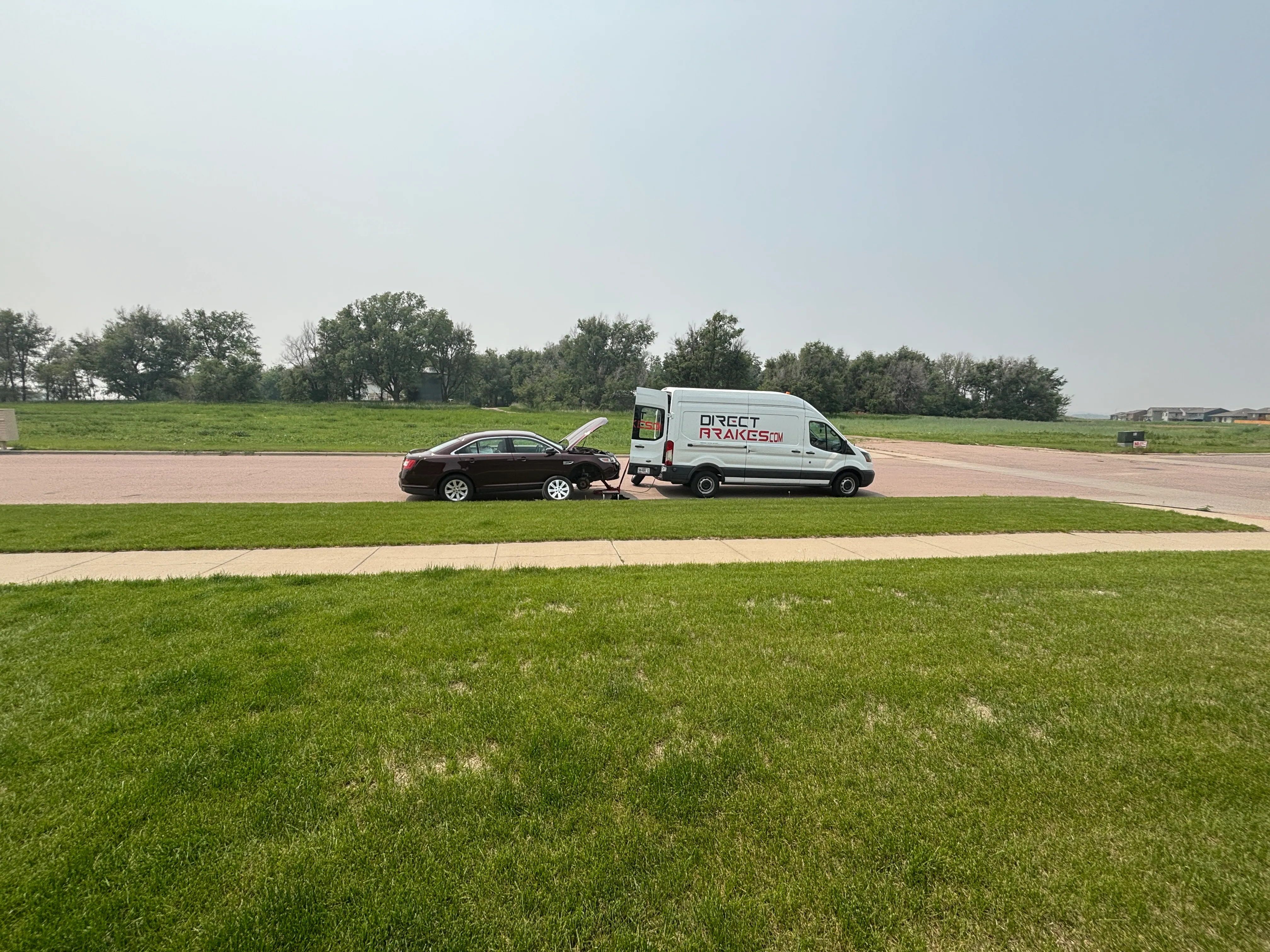
Labor cost is comparable or lower. Mobile operations have lower overhead than a physical shop — no rent, no lifts to finance. That savings passes through in some cases. Direct Brakes charges the same competitive rate as independent shops in our service areas, not dealership rates.
The real value is time. No drop-off, no waiting room, no rental car, no Uber from the shop. The job gets done at your home or office in the same 45–90 minutes it would take at a shop — while you do something else. For most people the time cost of a shop visit (drop-off, wait, pickup) runs 2–4 hours. That's the real comparison.
What mobile service can't do: Complex jobs requiring a lift (brake line replacement, wheel cylinder work on drum brakes, some seized-bolt situations). The vast majority of brake jobs — pads, rotors, calipers — are fully doable on jack stands. We do them every day.
Mobile brake repair: same price, no shop trip
2–4 hrs of your day
Your day stays intact
How to Read a Brake Quote — and What to Watch For
Getting multiple quotes is always smart for brake work. Here's how to make sure you're comparing apples to apples and what to watch for.
Make sure the scope is the same
One shop quotes pads only. Another quotes pads and rotors. They can't be compared directly. Ask every shop: "Does this quote include rotors or just pads?" and "Are both front and rear included, or just one axle?" A $180 pads-only quote and a $380 pads-and-rotors quote are not competitive — they're different services.
Ask what brand of pads and rotors
There's a meaningful quality difference between off-brand budget parts and name-brand OEM-equivalent parts. Ask specifically: what brand of pads, what brand of rotors? OEM-equivalent brands to look for: Bosch, Akebono, Wagner, Brembo, Raybestos, ACDelco (for GM vehicles). A quote using budget house-brand parts will be cheaper upfront but may result in more noise, shorter life, and higher dust output.
Watch for unnecessary upsells
Some shops automatically recommend full four-wheel replacement even when only one axle is worn. Ask to see the measurement: what's the current pad thickness front and rear, what's the minimum spec? If front pads are at 2mm and rear pads are at 7mm, you need front service only — the rear has thousands of miles left. A trustworthy shop will show you the numbers.
Confirm what the warranty covers
Most reputable brake pad brands carry a 12,000–24,000 mile warranty. Ask what the warranty is on parts and labor. A shop that charges more but backs the work with a strong warranty is often better value than the lowest quote with no warranty. Direct Brakes backs every brake job with the manufacturer warranty on parts.
Complete brake job cost reference — 2026
Frequently Asked Questions
Car pulling when you brake? Call (605) 376-2130 — we'll diagnose it and fix it at your door, same day.
Get an instant brake repair quote.
No shop trip. We come to your home or office. Same-day service in Sioux Falls and Omaha.
Get Free Quote (605) 376-2130