Bad Brake Caliper or Brake Hose? 5 Tests to Know for Sure
Direct Brakes February 26, 2025 10 min read Brake Diagnosis
Quick Answer — The One Test That Separates Them
Jack up the suspected wheel. Confirm it won't spin freely. Crack open the bleeder screw on that caliper. If the wheel spins free — it's the hose. If it stays stuck — it's the caliper. Everything else just helps you find which corner to test.
Run through all 5 tests below in order. Each one costs nothing and takes minutes. The bleeder test is Test 4 — the definitive answer.
Key Takeaways
A bad brake caliper and a collapsed brake hose feel identical from the driver's seat — both cause dragging, heat, pulling, and uneven wear.
A collapsed hose acts like a one-way valve — fluid flows in when you press the pedal, but can't flow back when you release. The caliper stays clamped.
This is one of the most commonly misdiagnosed brake problems — the caliper gets replaced, problem comes right back because the hose was never touched.
The bleeder screw test is the definitive separator. Wheel spins free after opening the bleeder = hose. Still stuck = caliper piston is seized.
Tools you need: gloves, a floor jack and jack stand, an 8mm or 10mm wrench, and some rags.
If you already replaced the caliper and the problem came back — the hose is almost certainly the real cause.
You've got a brake dragging on one corner. Hot wheel. Burning smell. The car pulling to one side. You know something is stuck — but is it the caliper itself, or is the brake hose collapsing internally and trapping pressure?
This is one of the most common misdiagnoses in brake work. A collapsed hose and a seized caliper feel completely identical. Mechanics replace the caliper, road test it, call it done — and the customer is back two weeks later with the exact same problem because nobody tested the hose.
These 5 tests walk you through exactly how to find the answer, in the order you'd actually do them on the job — no special equipment, no guesswork.
Caliper vs Hose — What's the Difference?
Before the tests — here's why these two fail differently, and why they feel the same from behind the wheel.
A bad caliper: The piston inside is seized. Corrosion, worn seals, or a bent piston means it won't retract when you lift off the brake. The pad stays pressed against the rotor constantly. The fix is replacing the caliper.
A collapsed brake hose: The rubber hose between the hard metal brake line and the caliper has deteriorated on the inside. The inner lining peels away and acts as a flap — fluid can push through toward the caliper when you press the pedal, but the flap blocks it from flowing back when you release. The caliper stays pressurized and the wheel drags. The caliper itself is fine. The fix is replacing the hose.
Symptom
Bad Caliper
Bad Hose
Wheel drags / won't spin
Yes
Yes — same
Hot rim after driving
Yes
Yes — same
Car pulls to one side
Yes
Yes — same
Uneven pad wear
Yes
Yes — same
Wheel free after opening bleeder
No — stays stuck
Yes — releases
Visible hose damage
No
Sometimes — often not
Fix
Replace caliper
Replace hose
What You Need
Floor jack + jack stand
8mm or 10mm open-end wrench
Work gloves
Shop rags (for brake fluid)
The 5 Tests — In Order
01
of 5
The Hot Rim Test
No tools needed — takes 2 minutes
No tools
Drive normally for 5–10 minutes — enough to get the car up to normal operating temperature. Pull over and park. Don't open the windows or cool anything off.
Put on gloves. Go to each wheel and carefully hover your palm about 2 inches from the rim — don't touch it directly, it can be extremely hot. You're checking which rim radiates more heat than the others.
A rim that is noticeably hotter than the other three tells you exactly which corner has a dragging brake. That's your suspect. Every other test from here gets focused on that wheel.
1
Drive 5–10 minutes at normal speed — city or neighborhood driving, not highway
2
Park and put gloves on immediately — don't let the car sit and cool
3
Hover your palm 2 inches from each rim — do not touch — and feel for heat difference
4
The rim that is clearly hotter than the others = the corner with the stuck brake
What it tells you
All four rims feel similar: No dragging brake detected from heat alone. Still run Tests 2–5 if you had symptoms driving.
One rim is clearly hotter: That corner has a dragging brake. Could be caliper or hose. Proceed to Tests 2–4 on that wheel.
02
of 5
The Spin Test
Jack up the suspect wheel and turn it by hand
Jack + stand
Jack up the wheel you identified in Test 1 and secure it on a jack stand. With the car in neutral and the parking brake off for that corner, grab the tire and try spinning it by hand.
A wheel with no drag should spin with moderate resistance — you'll feel the brake pads lightly touching the rotor, and you'll hear them scrape slightly. It shouldn't take a lot of effort to get it turning. A wheel that won't spin at all, locks up after a quarter turn, or feels like it's dragging through mud has a brake that is not releasing.
Also compare: jack up the opposite side and spin that wheel. The difference in resistance between a healthy wheel and a dragging wheel is obvious when you compare them back to back.
1
Safely jack up the hot wheel and place a jack stand — never work under a car on a jack alone
2
Put the car in neutral, parking brake off. Grip the tire at 9 and 3 o'clock
3
Try to spin the wheel. Note how much effort it takes and whether it stops abruptly
4
Optional: jack up the opposite side and compare. The difference will be obvious
What it tells you
Wheel spins with light resistance: No confirmed drag at this moment. The caliper may be intermittently sticking. Still check the hose visually in Test 5.
Wheel barely turns or won't spin: Brake is confirmed not releasing on this corner. Proceed to Test 4 — the bleeder test — to find out if it's the caliper or the hose.
03
of 5
The Pad Wear Comparison
Look through the spokes — no removal needed
Eyes only
With the wheel still jacked up, look through the spokes at the brake caliper. You can usually see the outer brake pad sitting in the caliper bracket. Now do the same on the opposite side.
A dragging brake eats through pads much faster on that corner. If one side's pads are noticeably thinner — or down to bare metal — while the opposite side still has plenty of material left, that confirms the dragging corner and tells you it has been going on for a while. This alone doesn't separate caliper from hose, but it confirms which corner is the problem if the hot rim test was inconclusive.
You can also check for scoring or grooves on the rotor surface visible through the spokes. A deeply grooved rotor tells you the pad has been grinding long enough to cause rotor damage — that corner will need pads and a new rotor regardless of which component is at fault.
What it tells you
Pads look even all around: The dragging may be recent or intermittent. Still run the bleeder test on the hot corner.
One side clearly more worn: Confirms ongoing drag at that corner. Proceed to Test 4. Also budget for pad and rotor replacement on that corner regardless of which part caused it.
04
of 5
The Bleeder Screw Test
The definitive test — separates caliper from hose
8–10mm wrench
This is the test. This is the one that tells you definitively whether you're looking at a caliper problem or a hose problem. It takes under 2 minutes once the wheel is off the ground.
The logic: if the brake hose has collapsed internally and is trapping pressure in the caliper — cracking open the bleeder screw releases that trapped pressure directly, bypassing the hose entirely. If the wheel then spins freely, the hose was holding the pressure. If the wheel stays stuck even with the bleeder open, the caliper piston itself is mechanically seized and the hose is fine.
How to Run the Bleeder TestThe Definitive Test
Wheel is jacked up and confirmed dragging (won't spin freely). Have a rag ready to catch brake fluid. Find the bleeder screw on the caliper — it's a small nipple-shaped valve, usually on the back or top of the caliper body.
Using an 8mm or 10mm wrench, crack the bleeder screw open about a half turn. Brake fluid will start weeping out. Watch the wheel.
Wheel spins free after opening the bleeder
The hose is the problem. It was trapping pressure inside the caliper. Opening the bleeder released the trapped fluid directly, bypassing the hose's internal flap. Replace the brake hose. Close the bleeder, bleed the system after the hose is swapped.
Wheel stays stuck even with bleeder open
The caliper piston is mechanically seized. Pressure isn't the issue — the piston physically won't retract. Replace the caliper. Close the bleeder and bleed the system after the caliper is swapped.
After the test
Close the bleeder screw before lowering the car. The brake system needs to be bled after whatever repair you make — opening the bleeder lets air into the line, and air in the lines means a soft brake pedal. Don't skip the bleed after the repair.
05
of 5
Hose Visual & Feel Test
Inspect for external damage — but know its limits
Hands only
With the wheel off the ground, find the flexible rubber brake hose — it's the section that runs from the hard metal brake line (bolted to the body or frame) down to the caliper. It's usually 10–15 inches long and looks like a thick rubber hose.
Look for: bulging or swelling anywhere along its length, surface cracking, soft spots, or areas that look darker or more worn than the rest. Run your fingers along the full length and squeeze it — a healthy hose should feel firm and consistent all the way through. A hose with a soft or squishy section has deteriorated internally.
Here's the important thing to know about this test: a collapsed brake hose can look completely fine on the outside. The internal rubber liner can peel and collapse without any visible exterior damage. This is why Test 4 — the bleeder test — is the real answer. Test 5 can catch obvious hose damage, but a clean exterior does not rule out a bad hose.
1
Locate the flexible rubber hose between the hard brake line and the caliper
2
Visually check the full length — look for swelling, cracks, darkened sections, or deformation
3
Squeeze it along its length — feel for soft spots or areas that give differently than the rest
4
Have a helper press the brake pedal while you watch the hose — a bad hose may visibly swell under pressure
What it tells you
Visible swelling, cracks, or soft spots: Hose is failing externally too. Replace it. The bleeder test already confirmed this was the issue.
Hose looks clean and feels fine: Does not rule out internal collapse. If the bleeder test showed the wheel freed up when you opened it, replace the hose even if it looks okay externally.
After You Know the Answer — What Gets Replaced
Once the bleeder test tells you which component is at fault, here's what the repair involves and what it costs at a mobile service versus a shop:
Bad Caliper — Replace It
Caliper only
$180–$280
Caliper + pads
$240–$360
Caliper + pads + rotor
$320–$520
The longer a stuck caliper drags, the more likely it's also damaged the rotor. If the rotor has grooves or heat marks, replace it at the same time — doing it separately later costs more in labor.
Bad Hose — Replace It
Hose only + bleed
$90–$160
Hose + pads
$160–$260
Hose + pads + rotor
$240–$400
Hose replacement is significantly cheaper than a caliper. Always bleed the system after replacing a hose — opening the line introduces air, which causes a soft pedal if not purged.
Already replaced the caliper and it came back?
If you or a shop already replaced the caliper on this corner and within weeks or months the same dragging returned — the hose was the real cause the whole time. The new caliper is fine. Replace the hose and bleed the system. It's a fraction of the cost and it will actually fix it.
Can't Get to the Bleeder Yourself? We Do It for You.
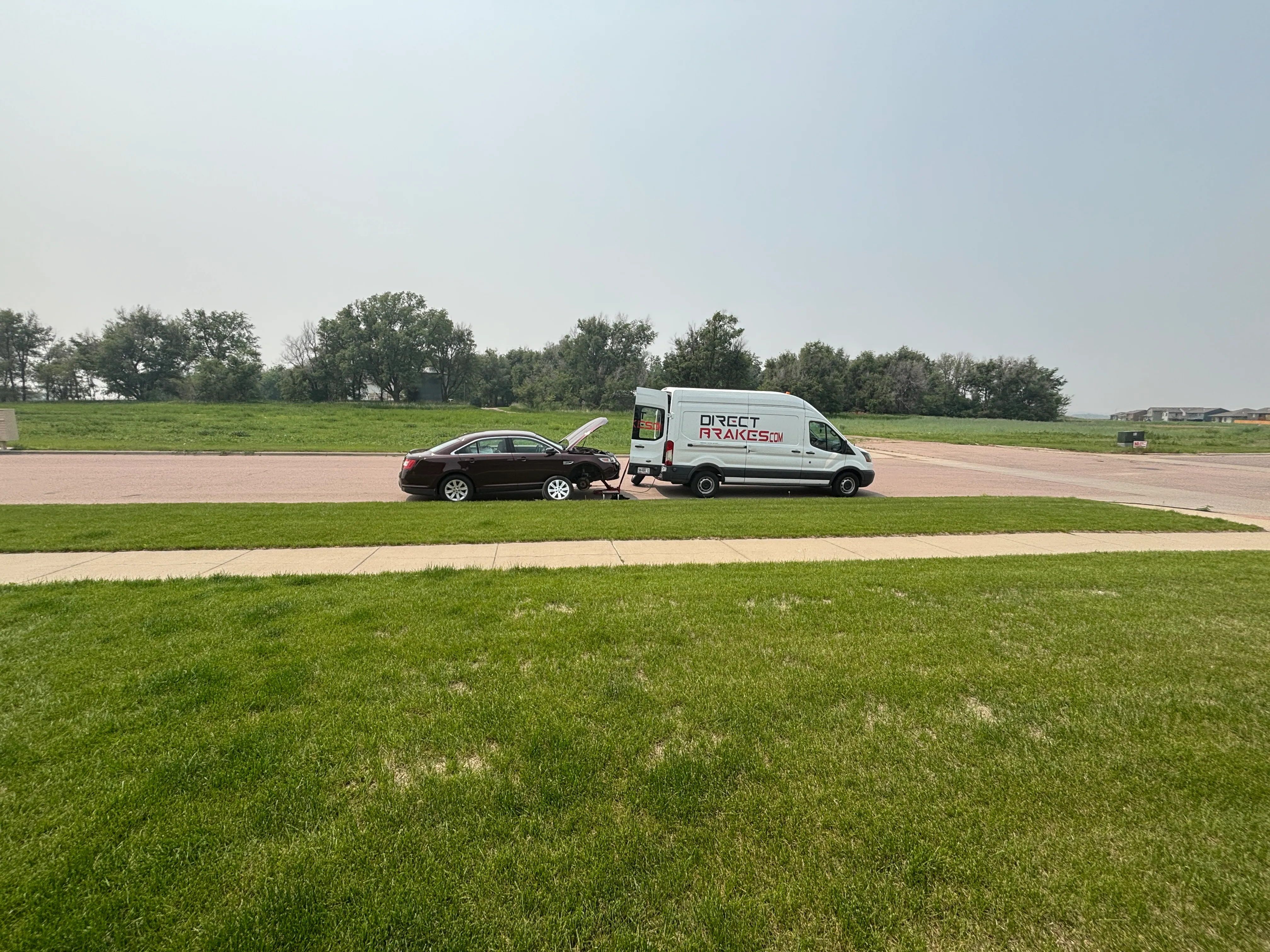
Direct Brakes comes to your driveway, runs a full brake diagnosis, and fixes the right part — not just the most obvious one. Sioux Falls, Brandon, Tea, Harrisburg. Written quote before we touch anything.
Run the bleeder screw test. Jack up the suspect wheel, confirm it won't spin freely, then crack open the bleeder valve on that caliper about half a turn. If the wheel immediately spins free — the hose was trapping pressure and needs to be replaced. If the wheel stays stuck — the caliper piston is seized and the caliper needs to be replaced. This test gives you a definitive answer in under 2 minutes.
Yes — this is one of the most commonly missed brake diagnoses. A brake hose that has collapsed internally develops an internal flap that allows fluid to flow toward the caliper when you press the pedal, but blocks the fluid from flowing back when you release it. The caliper stays pressurized and the wheel drags continuously. The caliper itself is not damaged — only the hose is the problem. Many mechanics replace the caliper first and the problem comes back because the hose was never addressed.
That's the problem — a collapsed brake hose often looks completely normal on the outside. The inner rubber lining deteriorates and peels, but the exterior of the hose can still look clean and undamaged. Sometimes you'll see swelling or bulging under pressure, sometimes you won't. This is why the bleeder test is the reliable answer — visual inspection alone is not enough to rule out a bad hose.
A stuck or seized caliper causes: the car pulling to one side when braking, one wheel rim noticeably hotter than the others after driving, uneven brake pad wear with one corner wearing much faster, a burning smell from one wheel area, and reduced fuel economy from constant drag. The wheel on that corner will be difficult or impossible to spin by hand when jacked up. These symptoms are identical to a collapsed brake hose — the bleeder test separates them.
Not safely and not for long. A continuously dragging brake generates massive heat. It burns through the brake pad rapidly — sometimes in days rather than weeks. The sustained heat warps the rotor. It can boil the brake fluid on that corner, leading to a soft or spongy pedal. Fuel economy drops noticeably. Long-term it damages wheel bearings. What would have been a $200–$300 repair turns into $500–$800 the longer you wait.
Almost certainly the brake hose. This is the most common scenario — the caliper was replaced, it seemed fine for a few weeks, then the dragging returned. The new caliper is probably not defective. The hose on that corner is collapsed internally and was trapping pressure the entire time. Run the bleeder test to confirm, then replace the hose and bleed the system. It will fix it.
Usually not in the typical way. Because the hose allows fluid to flow toward the caliper normally, the pedal often feels fine when pressing — the pressure gets through. The problem is the release. The hose traps that pressure so the caliper doesn't retract. You press and stop fine, but the brake never fully lets go. You might notice the pedal feels slightly firmer than normal over time as pressure builds up, but it's not the soft or spongy feeling you'd expect from a fluid leak or air in the lines.
We diagnose it right the first time. Direct Brakes mobile service comes to your driveway in Sioux Falls, Brandon, Tea, and Harrisburg — we run the tests, tell you exactly what's wrong, and fix only what needs fixing. 130+ five-star reviews.