
Key Takeaways
- Brake pads: 30,000–70,000 miles. Front pads for most drivers: 40,000–50,000. Rear pads: 20–30% longer
- Brake rotors: 50,000–80,000 miles — but almost always replaced at the same time as pads when pads reach metal contact
- Brake fluid: Every 2–3 years regardless of pad condition. Most drivers skip this and shouldn't
- Calipers: 75,000–100,000 miles under normal use — replaced earlier when they seize or leak
- Inspection interval: every 10,000–15,000 miles for most drivers. Every oil change for trucks, towers, and city drivers
- Waiting until grinding costs $150–$300 per axle more than replacing at the squeal stage
Brake Pads: Every 30,000–70,000 Miles
Brake pad replacement interval is the question everyone asks — and the honest answer is that the range is wide because the variables are wide. Here's how to think about where you land.
Front vs. rear pads
Front pads always wear faster. Front brakes handle 60–70% of stopping force because braking shifts vehicle weight forward. The practical consequence: front pads for most drivers last 40,000–50,000 miles. Rear pads last 55,000–70,000 miles on the same vehicle. It's completely normal to replace fronts twice before the rears need service — that's not a sign of a problem, it's physics. Always ask for separate front and rear inspection numbers. They are not the same job on the same schedule.
By pad type
Organic pads (softer compound, found on economy vehicles and as OEM on some Japanese makes) last 25,000–40,000 miles. Semi-metallic pads (the most common type on trucks, SUVs, and performance vehicles) last 40,000–60,000 miles. Ceramic pads (quietest, least dust, increasingly standard on newer vehicles) last 50,000–70,000 miles. If you drive a newer model-year vehicle, you likely have semi-metallic or ceramic pads from the factory. Check your owner's manual or ask at your next service if you're not sure.
By driving style
City stop-and-go driving can reduce pad life by 40–50% compared to highway driving. A commuter who does 40 miles of city driving may brake 80–100 times per trip. A highway commuter doing the same 40 miles may brake a dozen times. Both put the same miles on the vehicle, but the city driver's pads are working five to eight times as hard. Aggressive high-speed braking is the other major accelerant — stopping from 60 mph requires four times the energy as stopping from 30 mph, because kinetic energy scales with the square of velocity. See our full breakdown in the how long do brake pads last guide.
By vehicle weight
More mass means more stopping energy per stop. A 6,000 lb full-size SUV or pickup truck wears brake pads measurably faster than a 3,200 lb compact sedan at the same speeds and frequency. Towing amplifies this further — a truck towing 8,000 lbs has roughly three times the stopping energy to manage compared to unladen. Truck and SUV owners who tow regularly should plan for pad replacement at the lower end of the range and inspect at every oil change.
Brake Rotors: Every 50,000–80,000 Miles (or Sooner)
Rotors have a longer service life than pads, but they are almost always replaced at the same time as pads — which is why this topic is inseparable from pad intervals.
Why rotors rarely outlast two sets of pads
Rotors have a manufacturer minimum thickness spec. Every braking event removes a microscopic layer of rotor material along with pad material — the friction goes both ways. By the time you're on your second or third set of pads, rotors are typically near or at their minimum thickness. A shop measures rotor thickness with a micrometer at every brake job. If the rotor is within spec and the surface is in good condition, it can be reused. If it's at or below minimum, it's replaced regardless of surface condition.
When pads reach metal contact
If brake pads are allowed to wear past the friction material to the metal backing plate, every stop carves grooves into the rotor surface. This scoring means the rotor must be replaced — a scored rotor surface causes vibration and noise even with brand-new pads installed. This is the most common reason rotors get replaced ahead of the expected interval. The fix is simple: don't ignore the wear indicator squeal. See our brake warning signs guide for the full urgency breakdown.
Warping from heat cycling
Repeated heavy braking — mountain descents, sustained stop-and-go in summer heat, aggressive driving — cycles rotors through extreme heat and cooling repeatedly. Over time this causes microscopic variations in rotor thickness (disc thickness variation, or DTV) that produce the pedal pulsing and steering wheel shake that drivers call "warped rotors." Technically it's less about warping and more about thickness variation, but the outcome is the same: the rotor needs to be replaced. Resurfacing on a brake lathe can address early-stage DTV if enough material remains above minimum spec — but given the low cost of replacement rotors today ($40–$80 each for most domestic vehicles), most shops default to replacement.
Rotor replacement triggers — any one requires replacement
Brake Fluid: Every 2–3 Years
Brake fluid is the most neglected part of brake maintenance — and it matters more than most drivers realize.
Brake fluid is hygroscopic, meaning it actively absorbs moisture from the surrounding air through the rubber seals in the brake system. This is unavoidable — it happens continuously from the day the fluid is installed. As moisture content rises, the fluid's boiling point drops. Fresh DOT 3 brake fluid has a dry boiling point around 401°F. Fluid with 3.7% water content has a wet boiling point of roughly 284°F — a 29% reduction in heat tolerance.
Why this matters: under sustained heavy braking — descending a long grade, emergency stops in succession, track driving — brake fluid can approach its boiling point. When fluid boils, it creates vapor pockets in the lines. Vapor compresses (liquid doesn't), which causes the brake pedal to suddenly go soft or to the floor. This is called vapor lock, and it's a serious safety failure.
Beyond vapor lock risk, moisture-contaminated fluid corrodes the internal components it contacts — caliper pistons, brake lines, master cylinder bore. Regular fluid changes extend caliper life and prevent brake line corrosion, both of which are significantly more expensive repairs than a $80–$130 fluid flush.
Manufacturer intervals vary — most say 2–3 years
BMW specifies fluid replacement every 2 years regardless of mileage. Honda and Toyota: every 3 years or 45,000 miles. Many domestic manufacturers recommend 3 years or 45,000 miles. Some vehicles have a brake fluid quality sensor that warns when moisture content is too high. If your vehicle doesn't have one, the interval applies regardless. The test: a shop can check brake fluid moisture content in minutes with a test strip or refractometer — ask for it at your next oil change.
Brake fluid flush: $80–$130. Caliper replacement from corrosion damage: $300–$500. The math is easy.Brake Calipers: 75,000–100,000 Miles (or When They Fail)
Calipers are the hydraulic clamps that squeeze the pads against the rotors when you brake. They're built to last — but they do fail, and when they do, the symptoms are hard to miss.
Normal caliper life
Under normal conditions with regular brake fluid changes — which prevent the internal corrosion that degrades caliper pistons and seals — calipers routinely last 75,000–100,000 miles or more. They're not a "scheduled replacement" item the way pads and fluid are. You replace them when they fail or when inspection reveals a problem.
What causes calipers to fail early
Seized piston or slide pins — the most common failure. Corrosion from moisture-contaminated fluid, or from lack of periodic lubrication on the slide pins, causes the caliper to stick partially applied. A seized caliper keeps the pad in continuous light contact with the rotor, generating constant heat, accelerating wear on that corner's pad and rotor, and causing the car to pull toward the seized side when braking. Collapsed brake hose — the rubber hose between the hard line and the caliper can degrade internally, creating a one-way valve effect: fluid pushes through to apply the caliper but can't release fully. This mimics a seized caliper symptom. See our caliper and brake hose test guide.
Signs a caliper needs to be replaced now
Car pulls to one side when braking (not caused by tire pressure or alignment). One wheel significantly hotter than the others after driving. Pads on one corner worn dramatically more than the other three. Brake fluid leak at the caliper (wet or stained area). Grinding from one specific corner even after pads were recently replaced. Any of these symptoms on a specific wheel — not generalized across the vehicle — point to a caliper problem on that corner.
Seized caliper = same-day inspection — it accelerates rotor and pad damage every mile you driveComplete Brake Maintenance Schedule
Here's how to translate all of the above into an actionable schedule based on your situation.
For the average commuter (mixed city/highway, no towing)
Brake inspection: every 10,000–15,000 miles, or with every other oil change. Front pad replacement: around 40,000–50,000 miles. Rear pad replacement: around 55,000–70,000 miles. Rotor replacement: typically with the second set of pads (around 60,000–80,000 miles front) unless scored before then. Brake fluid: every 2–3 years. Calipers: replace when symptoms develop, not on a schedule.
For city-only drivers
Brake inspection: every oil change (the extra frequency is worth it — city pads can go from 50% life to 0 between inspections). Front pad replacement: as early as 25,000–35,000 miles. Brake fluid: every 2 years (more frequent braking means more heat cycling, accelerating moisture absorption). Everything else follows the symptom-based approach above.
For truck and SUV owners who tow
Brake inspection: every oil change, no exceptions. Towing triples the stopping energy per stop — pads can wear in 20,000–30,000 miles if you tow regularly. Use semi-metallic or heavy-duty pads rated for your tow capacity. Brake fluid: every 2 years. Keep a closer eye on caliper condition — towing heat is hard on seals.
For used vehicle buyers
Get a brake inspection immediately. You have no history on the previous owner's maintenance habits, braking style, or the current pad thickness. The cost of a brake inspection is zero at most shops — the cost of discovering a brake problem on the road is much higher. Specifically ask for: front and rear pad thickness measurement in millimeters, rotor thickness vs. spec, and a brake fluid moisture test.
Signs It's Time to Replace Your Brakes — Regardless of Mileage
Mileage intervals are useful guidance, but your brakes will tell you when they need attention more reliably than any odometer reading. These signs override the schedule.
🔴 Stop driving — same-day service
Grinding metal sound when braking — pads are past the friction material, metal plate on rotor. Every stop worsens the rotor damage. Brake pedal goes to the floor or feels very soft — brake fluid issue, air in the lines, or master cylinder failure. Burning smell from one wheel — seized caliper keeping pads clamped, potentially heating fluid toward vapor lock. See our burning smell from brakes guide.
🟡 Service within the week
High-pitched squeal when braking — wear indicator. You have days to a couple of weeks. Don't push it to grinding. Car pulling to one side when braking — caliper or hose issue on one side. See our car pulling when braking guide. Brake warning light illuminated — electronic wear sensor triggered. Same urgency as a squeal. Vibration through the pedal or steering wheel when braking — rotor issue. See our car shaking when braking guide.
🟢 Schedule at your next convenience
Pads measured at 4mm at inspection (above the 2–3mm wear indicator threshold, but getting close). Rotor thickness approaching minimum spec but not yet there. Brake fluid test showing elevated moisture content. Any squeal that appears only after overnight rain and disappears after a few stops (surface rust — normal and harmless).
Grinding = same day · Squeal = this week · Vibration = this weekHow Often to Get a Brake Inspection
A brake inspection is the practical tool that makes all these intervals actionable. You don't need to remember the exact mileage your pads were last replaced — you need a technician to measure what's left and tell you where you stand.
Every 10,000–15,000 miles for most drivers
This roughly corresponds to every other oil change on a modern vehicle. A brake inspection at this frequency gives you enough visibility to catch pads reaching 3–4mm while you still have time to schedule service without urgency. The cost of a brake inspection at most shops: free to $20. The cost of discovering you're at metal contact and need emergency same-day service: much higher.
Every oil change for high-wear drivers
If you're in any of these categories, inspect brakes every oil change: city-only drivers, trucks and SUVs over 5,000 lbs, anyone who tows regularly, drivers in mountainous terrain, anyone with an aggressive driving style. The inspection is fast and cheap. The alternative is discovering a brake problem when it becomes expensive.
What a brake inspection should include
Pad thickness measurement (front and rear, in millimeters), rotor thickness measurement vs. manufacturer minimum spec, visual check of caliper condition and hardware, brake hose visual inspection, and a brake fluid moisture test. Ask for the specific numbers — pad thickness in mm, not just "good" or "needs replacement soon." Numbers let you track wear rate between inspections and predict when you'll actually need service.
Direct Brakes: Free brake inspection at your door
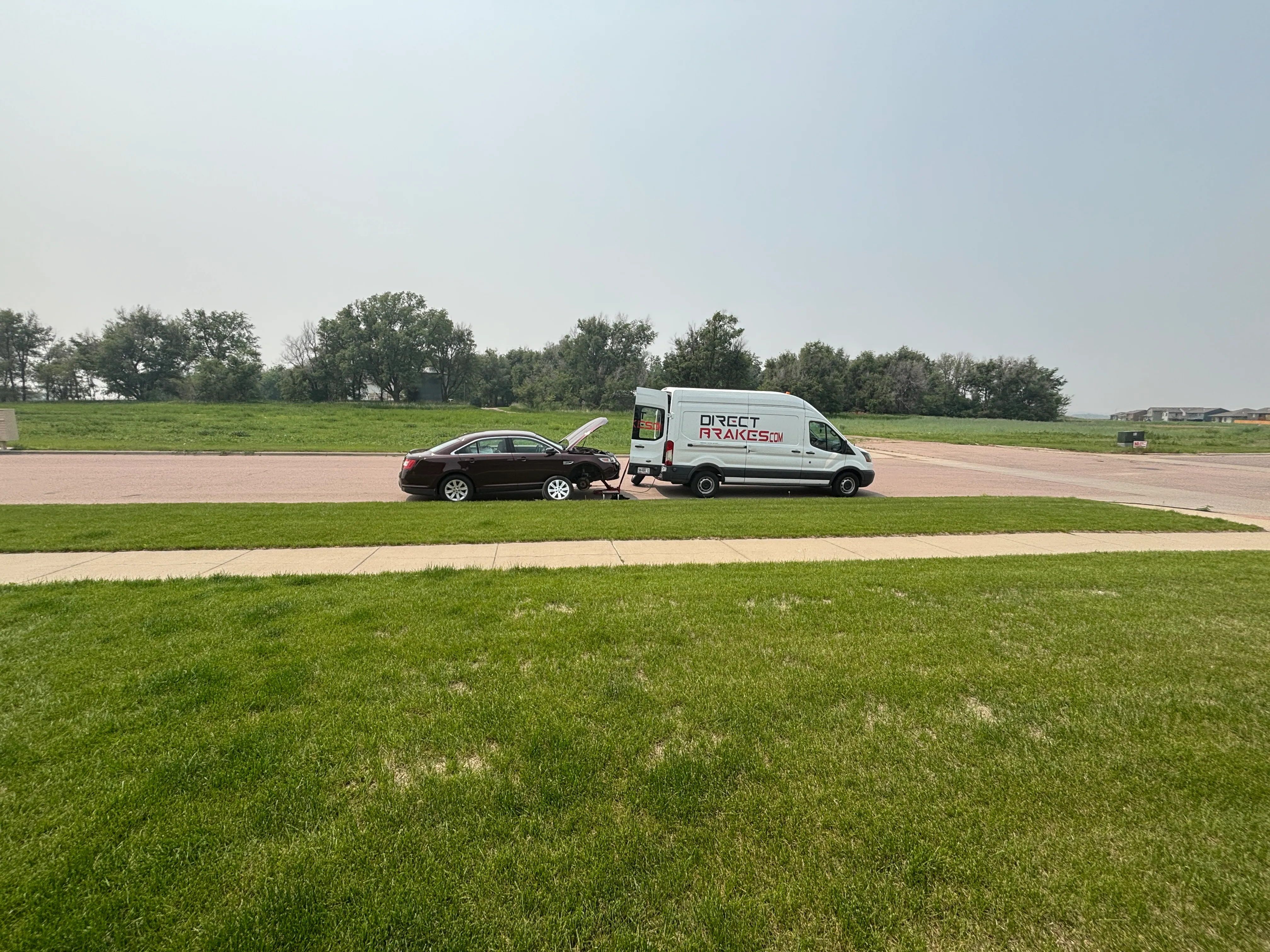
We come to your home or office, measure front and rear pad thickness and rotor condition, and give you the numbers. If replacement is needed, we can do it same day. No shop trip, no waiting room. Serving Sioux Falls and Omaha.
Frequently Asked Questions
Car pulling when you brake? Call (605) 376-2130 — we'll diagnose it and fix it at your door, same day.
Free brake inspection at your door.
We measure pad thickness and rotor condition on-site and tell you exactly where you stand. Same-day service in Sioux Falls and Omaha.
Get Free Quote (605) 376-2130