
Key Takeaways
- If the grinding happens when braking while turning — it's almost always a brake problem, not a wheel bearing
- Worn pads with metal-on-metal contact get louder during turns because weight shifts onto the outside wheels
- A bent dust shield only contacts the rotor when the suspension flexes during cornering — that's why it grinds in turns and not on straight roads
- A seized caliper grinding during turns also pulls to one side and runs one wheel hot — three symptoms together
- Pure turn-only grinding with no brake input = wheel bearing or CV joint — Direct Brakes can diagnose it at your door
The diagnostic split — use this first
Grinding when turning AND braking (or coasting to a stop): brake problem — read the four causes below.
Grinding only when turning with no brake input, especially at low speed: more likely a wheel bearing (louder in one turn direction) or CV joint (clicking/grinding during tight turns).
Most people can answer this question before calling a mechanic.
Worn Brake Pads — Metal on Metal
The most common brake cause of grinding during turns. When brake pads wear through their friction material entirely, the steel backing plate contacts the rotor directly. That metal-on-metal contact produces a harsh grinding sound — and it often becomes noticeably louder when cornering because turning shifts vehicle weight to the outside wheels. That lateral load increases the pressure between the worn pad and rotor, amplifying the noise in a turn versus driving straight.
The grinding should also be present when braking on a straight road — the turn just makes it more obvious. If it's grinding during a turn but completely silent during straight-line braking, worn pads are less likely to be the only cause.
How to confirm it
Look through the wheel spokes at the brake caliper — you should be able to see the outer brake pad pressed against the rotor. If the friction material is paper-thin or you can see the metal backing plate, you're there. Most pads have a wear indicator tab that squeals when pads are low; if you're past squealing into grinding, you've gone through the indicator and into metal contact.
The fix
Pads and rotors — at this stage the rotor surface has scoring from metal contact. Replace both sides of the axle. See our brake pad replacement cost guide for pricing by vehicle. Same-day service — every stop is scoring the rotor further.
Same-day — rotors being damaged every stopBent or Loose Brake Dust Shield
The brake dust shield — also called the backing plate or splash guard — is a thin sheet metal plate that mounts behind the rotor to protect brake components from road debris and water. It's not structural and isn't designed to contact the rotor under any circumstances. But it can get bent inward from road debris strikes, minor curb impacts, or occasionally during a brake job if something catches it.
Here's why it grinds specifically during turns: when you turn, the front suspension compresses on the outside and extends on the inside as weight transfers. That suspension movement changes the geometry between the dust shield and the spinning rotor. On a straight road the gap is sufficient; at full suspension travel during cornering, the bent shield flexes inward and contacts the rotor face. The grinding is often intermittent — present on sharper turns or over bumps, absent on smooth straight roads.
How to confirm it
Pull the wheel and look behind the rotor at the backing plate. A bent shield will have a visible scrape or wear mark where it's been contacting the rotor surface. You may see a bright polished stripe on the rotor where the edge of the shield has been rubbing. The shield itself will be visibly deformed rather than sitting flat and parallel to the rotor.
The fix
Bend it back. A flat-head screwdriver or small pry bar is usually sufficient — the metal is thin enough to move by hand. The goal is to restore at least 5–10mm of clearance around the entire circumference of the rotor. If the shield is badly deformed or torn, replacement is the right call — they're inexpensive. This is the cheapest possible brake-related fix for turn-specific grinding.
Usually a 5-minute fix — cheap if shield needs replacingSeized Caliper Dragging the Pad
A caliper that won't fully release keeps the brake pad in constant light contact with the rotor. On a straight road this produces a constant low-level grinding or scraping that you might dismiss as road noise. During a turn — with additional lateral load on the outside front or rear wheel — that dragging contact intensifies and becomes distinctly louder. The key tell for a seized caliper is the combination of symptoms: grinding that gets worse in turns, a pull to one side when braking, and a wheel that runs significantly hotter than the others after a drive.
The caliper drags because its slide pins have corroded and stopped allowing the caliper to float freely, or because the piston itself is seized in a partially extended position. Either way the pad never fully releases and the friction material wears extremely fast on that corner — often dramatically more worn than the pad on the opposite side of the same axle. That uneven wear is itself a diagnostic clue.
How to confirm it
After a 10-minute drive, hold your hand near each wheel without touching (rotors can exceed 300°F). A seized caliper will radiate noticeably more heat from one corner. Check pad thickness on both sides of the axle — if one side is significantly more worn, that's the dragging side. See our full caliper test guide for a step-by-step diagnosis.
The fix
Slide pin service if caught early: $80–$150. Caliper replacement if the piston is corroded: $150–$350 per corner, usually with new pads and rotor on that side. Don't drive it — a dragging caliper can boil the brake fluid at that corner and cause pedal failure.
Stop driving — brake fluid boiling risk if leftBrake Pad Stuck in Caliper Bracket
Brake pads slide in and out of the caliper bracket (carrier) on machined slots or abutment clips. Those slots can corrode and pack with rust scale over time, preventing the pad from retracting cleanly after each stop. A pad that's stuck or binding in its bracket keeps friction material in partial contact with the rotor — similar to a seized caliper, but the cause is in the bracket rather than the caliper itself.
Like the dust shield issue, this often shows up specifically during turns because the lateral forces during cornering can cause the stuck pad to bind harder in its slot, increasing contact. The noise tends to be a scraping or grinding that happens intermittently, sometimes accompanied by a slight jerk or hesitation when the car first moves from a stop as the stuck pad breaks free before reseating.
How to confirm it
Remove the wheel and try to move the brake pad by hand in its bracket slot. It should slide in and out with finger pressure. If it's immovable or requires significant force, the slide surface is corroded. Inspect the abutment clips — if they're rusted through or missing, the pad has been riding bare metal in the bracket slot.
The fix
Clean the bracket slides with a wire brush and brake cleaner, apply fresh caliper grease to the slide surfaces, and install new abutment clips. This should be part of every brake job — it's a $10–$20 hardware kit that prevents a $300 problem. If the bracket itself is corroded beyond cleaning, replacement is required.
Service this week — inexpensive fix if caught before pad damageIf it only grinds when turning — with no brake input
Grinding that happens purely during turning with no braking — especially at low speed or in parking lots — is more likely a wheel bearing (louder turning in one specific direction, rumbles at highway speed) or a CV joint (clicking or grinding on tight turns, more pronounced under acceleration). These aren't brake problems, but Direct Brakes can diagnose them at your door and tell you exactly what you're dealing with before you pay anyone to fix anything.
Grinding When Turning: Read the Pattern
New grinding noise = same-day diagnosis
All four brake causes on this page worsen with every mile driven — worn pads score the rotors, a seized caliper boils the fluid, a stuck pad accelerates uneven wear. A new grinding noise that wasn't there yesterday shouldn't wait until the weekend. The earlier it's caught, the cheaper the fix.
Frequently Asked Questions
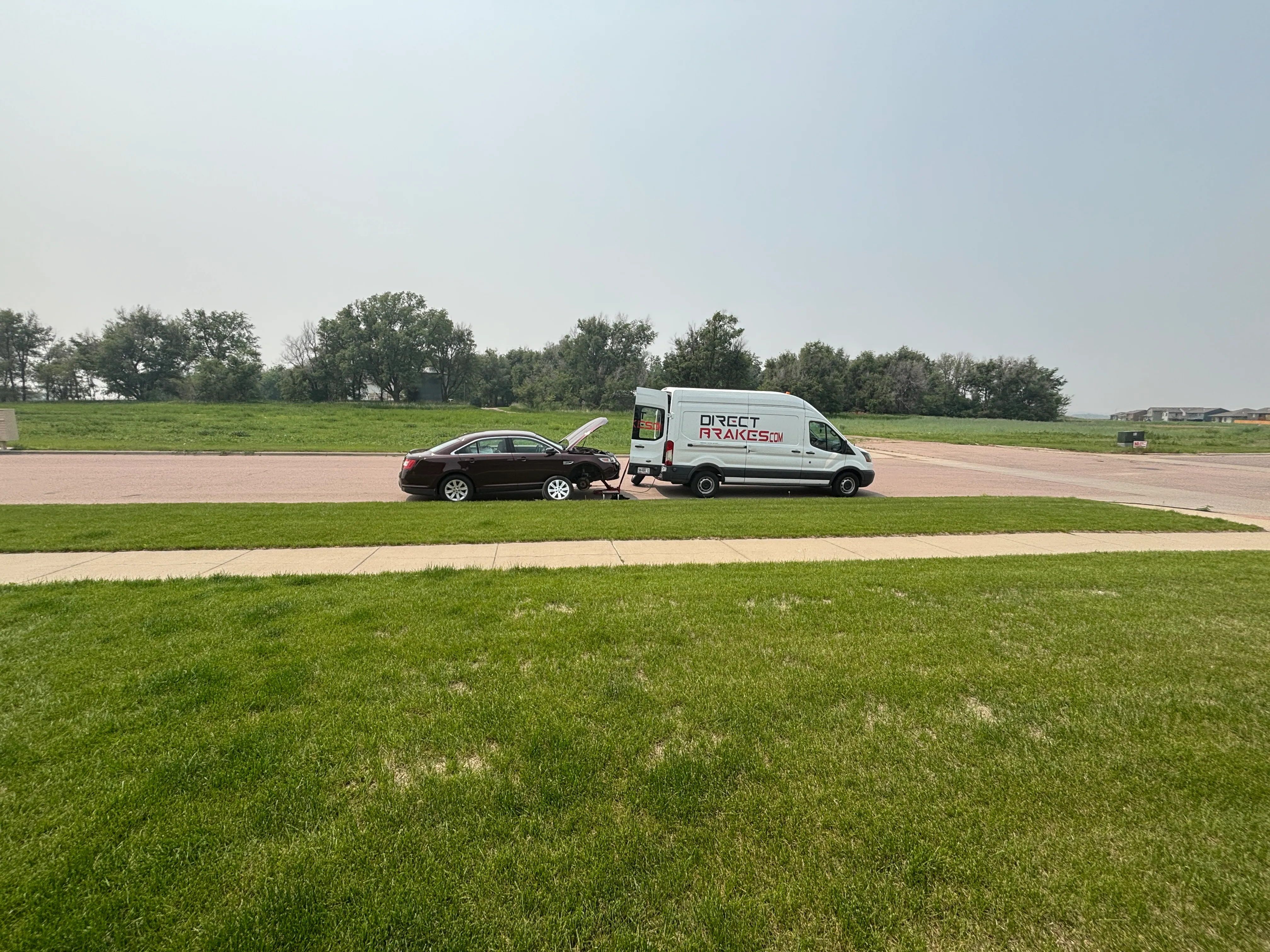
Car pulling when you brake? Call (605) 376-2130 — we'll diagnose it and fix it at your door, same day.
Grinding noise when turning?
We diagnose it at your door — brakes, bearing, or CV joint. Same-day appointments available.
Get Free Quote (605) 376-2130