
Key Takeaways
- New brakes almost always feel different for the first 100–500 miles — this is bedding, not a problem
- Normal: light squeal for a few days, mild burning smell, slightly stiff or high pedal, reduced initial bite
- Not normal: soft/spongy pedal, grinding metal sound, car pulling to one side, hard vibration when braking
- Hard stops in the first 200 miles can glaze the pads — moderate braking during break-in produces better long-term results
- Most symptoms that feel odd after new brakes resolve on their own within 200–400 miles of normal driving
What "Bedding In" Means and Why It Changes How Brakes Feel
The reason new brakes feel different comes down to surface chemistry. When new pads are installed on a freshly machined or replaced rotor, both surfaces are smooth and uniform. Effective braking depends on a thin, even layer of pad compound transferring onto the rotor face — creating a consistent friction interface that performs predictably under heat.
That transfer layer doesn't exist on day one. It builds up over the first 200–500 miles through a process called bedding. During this period, braking may feel slightly different in character from what you're used to — the pedal may feel higher, the initial bite may feel lighter, and the engagement point may shift slightly. All of this is the surfaces mating to each other.
The same process applies to the resins in the pad compound. New brake pads contain organic binders that cure under heat — the first several dozen hard stops drive off residual gases and complete the curing process. This is the source of the brief burning smell most people notice after new brake installation. It's normal, it's temporary, and it means the pads are doing exactly what they're supposed to do.
New brakes feeling different is expected. The surfaces need 200–500 miles to fully mate.What's Normal After New Brake Installation
Here's every common "feels weird" symptom after a brake job — and whether it's expected or worth a call back to your tech.
What's Not Normal After New Brakes
These symptoms after a brake job are not part of normal bedding and warrant a call back to whoever did the work.
Soft or spongy pedal — call back immediately
A soft pedal that sinks toward the floor without firm resistance means air is in the brake lines. This almost always comes from a brake job where a caliper was replaced and the lines weren't bled properly — or where the master cylinder was disturbed and air entered the system. Air in brake lines compresses under pedal pressure in a way fluid doesn't, causing exactly this spongy feeling. It does not resolve on its own. The fix is bleeding the brake lines — a 30-minute job. Call back the shop or tech and have it corrected. See our brake pedal going to the floor guide for the full rundown.
Grinding metal sound — wrong pads or missing hardware
Metallic grinding immediately after a brake job means something went wrong during installation. Most common causes: a brake pad anti-rattle clip or shim was omitted and the pad is vibrating against the caliper bracket at the wrong frequency, a debris shield (dust shield) was bent during installation and is contacting the rotor, or — less commonly — the wrong pad was installed and doesn't seat correctly in the caliper. A grinding sound right after a fresh brake job always warrants immediate inspection. Don't drive on it and assume it'll break in.
Car pulling to one side when braking — caliper not seated
A new brake job that causes the car to pull left or right under braking almost always means a caliper was not correctly seated or torqued during installation, a caliper slide pin was assembled dry without lubrication and is binding, or mismatched pad compounds were installed (different brand or spec on one side vs. the other). This is an installation error. Have it corrected before putting more miles on the brakes. See our car pulling when braking guide for diagnosis steps.
Vibration when braking after 200+ miles — rotor seating issue
Some light roughness in the very first miles is normal (machined rotor texture). Vibration through the pedal or steering wheel that persists or develops after 200+ miles is not. The most common cause after a fresh brake job: wheel lug nuts were not torqued in the correct star pattern, causing the rotor to seat slightly unevenly on the hub. This creates the same disc thickness variation (DTV) effect as a heat-warped rotor. The fix: remove the wheel, re-seat the rotor on the hub, reinstall and torque the wheel in proper sequence. See our shaking when braking guide.
Burning smell from one specific wheel after 500+ miles
A smell from both wheels during break-in is normal resin curing. A persistent burning smell coming noticeably from one wheel after 500 miles means a caliper on that corner is partially seized — keeping the pad in light continuous contact with the rotor even when you're not braking. This generates constant heat on that corner. Check whether that wheel feels dramatically hotter than the others after a drive. If it does, the caliper needs to be inspected. See our burning smell from brakes guide.
Call back your tech if you have any of these
Glazed Pads: What Happens When You Brake Too Hard Too Soon
Hard aggressive stops in the first 200 miles of new brake installation can cause a problem called glazing — and it's one of the most common reasons new brakes end up feeling worse than expected long-term.
Here's what happens: during bedding, the pad resin is still curing and the transfer layer on the rotor is still building. If you make several hard stops from high speed during this period, the pad surface heats beyond the resin's cure temperature before curing is complete. Instead of developing a proper friction surface, the pad face hardens into a smooth, glassy layer. This glazed surface has significantly less friction than a properly bedded pad — brakes feel grabby at low speed and inconsistent at higher speeds, and the squeal it creates often doesn't resolve on its own.
How to avoid it: for the first 200 miles after a brake job, use moderate braking. Stop from 35–40 mph using steady, progressive pressure. Avoid hard panic stops unless necessary. Avoid riding the brakes on long descents. After 200 miles, a few moderate-hard stops from 45–50 mph will complete the bedding process. The result is a pad surface that performs correctly and quietly for thousands of miles.
If pads are already glazed — you recognize the symptoms (glassy, inconsistent bite, squeal that doesn't clear) — they can sometimes be de-glazed by a series of moderate-to-firm stops from 45 mph, allowing full cooling between stops. If that doesn't resolve it, the pads may need to be replaced. See our brakes squeaking guide for the full glazing diagnosis.
First 200 miles: moderate braking. No hard stops. Let the surfaces mate properly.How Different Pad Types Feel During Break-In
The pad material on your new brakes affects how they feel during bedding — and how long bedding takes.
Organic pads
The easiest break-in of the three types. Softer compound, lower initial heat, resins cure quickly. Most organic pads feel close to normal within 100–150 miles. They're quiet and smooth during bedding with minimal odor. The tradeoff is shorter overall lifespan. Most economy vehicles and some Japanese OEM applications use organic pads from the factory.
Semi-metallic pads
The most common type — found on most trucks, SUVs, and performance-oriented vehicles. Break-in takes slightly longer than organic, typically 200–400 miles for full transfer layer development. More noticeable squealing during bedding (the metallic content makes more noise against the rotor during the mating process), and more burning smell as the higher-temp resins cure. The squeal during bedding on semi-metallic pads often prompts a call back to the shop — but in most cases it's completely expected and temporary.
Ceramic pads
Longest break-in of the three types — 300–500 miles for the transfer layer to fully establish. During bedding, ceramic pads may feel very smooth and progressive, sometimes described as "not biting enough" compared to old worn semi-metallic pads. This is normal — ceramic pads are designed for consistent, smooth stopping rather than sharp initial grab. They produce the least noise and dust during bedding. The feel improves steadily as the transfer layer builds and reaches its best performance after full break-in.
If you switched pad types from what was on the car before — for example, from semi-metallic to ceramic — the feel difference during and after bedding will be more pronounced than if the same type was reinstalled. Ceramic pads simply feel different in character from semi-metallic pads, not worse.
What to Do If Something Feels Wrong After a Brake Job
Here's a clear decision tree depending on what you're experiencing.
If it's within the first 200 miles and you have mild squeal, light smell, or slightly different pedal feel
Drive it. This is bedding. Check back in 200–300 miles. Use moderate braking during this period — no hard stops. The symptoms will diminish steadily and most will be completely gone by 400 miles.
If squeal persists past 500 miles and gets louder over time
Call back your tech. Most likely causes: anti-squeal shims were omitted, slide pins weren't lubricated, or pads were glazed from aggressive early braking. All are fixable. A reputable brake shop will address installation-related issues under their warranty. See our brake squeal causes guide for the full diagnosis.
If you have a spongy pedal or grinding — call back immediately
These are installation errors, not break-in symptoms. Spongy pedal = air in lines from incomplete bleeding. Grinding = missing hardware or wrong parts. Neither resolves with more driving. Your shop is responsible for correcting these at no additional charge. Don't let a shop tell you grinding after a fresh brake job is "normal break-in."
If the car pulls when braking or vibrates hard after 200+ miles
Get it back to whoever did the work. Pulling after a new brake job is a caliper seating or slide pin issue. Persistent vibration after 200 miles is usually an improper lug torque or rotor seating problem. Both are installation-related and should be corrected by the tech who did the job.
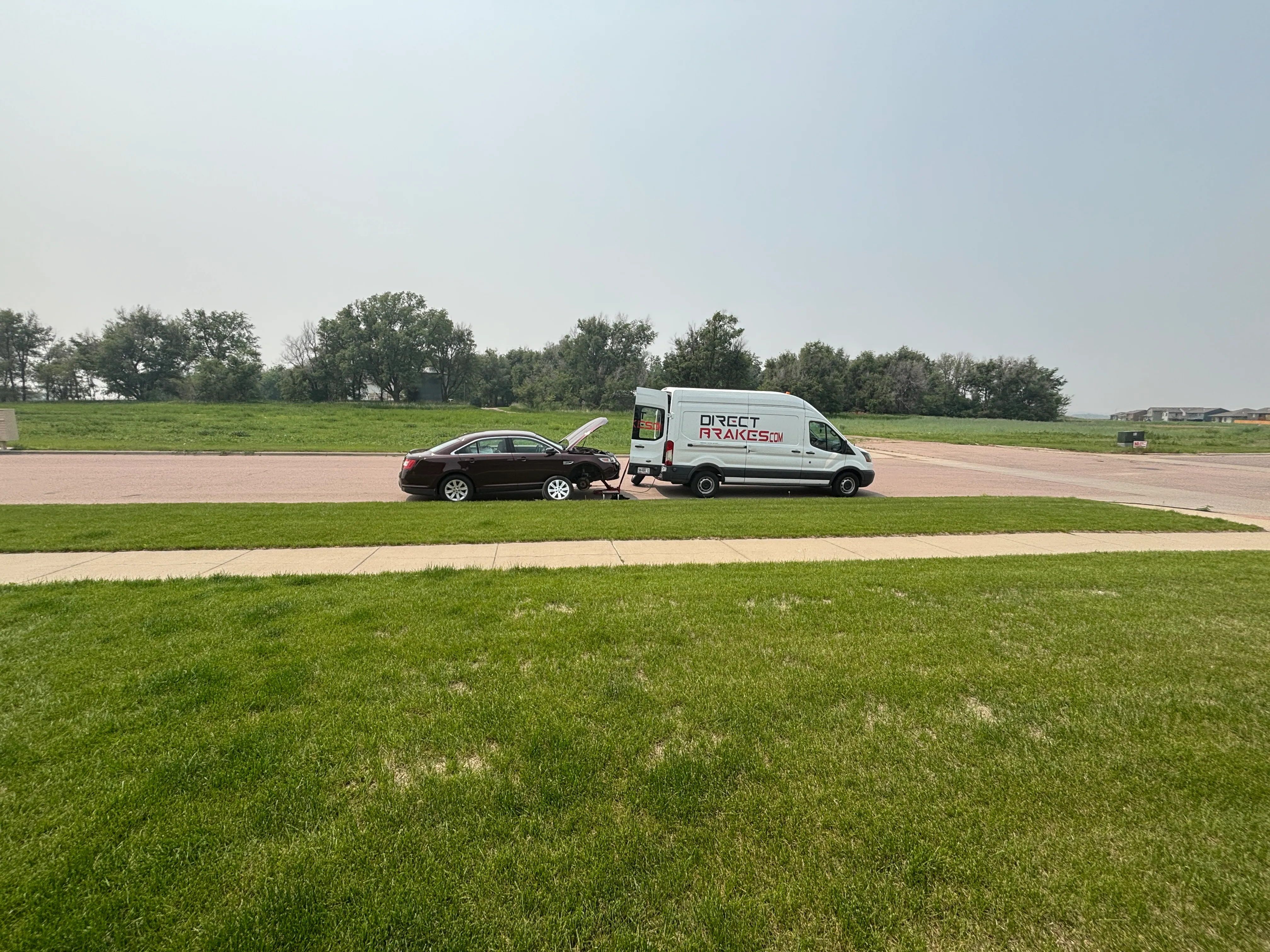
Direct Brakes: Every brake job backed by manufacturer warranty
If something feels wrong after a Direct Brakes service call, we come back. Spongy pedal, squeal, pulling — we address it. Mobile service means we were already at your door once. We'll come back again.
Frequently Asked Questions
Car pulling when you brake? Call (605) 376-2130 — we'll diagnose it and fix it at your door, same day.
New brakes not feeling right?
We back every brake job. If something feels off after a Direct Brakes service, we come back and make it right. Same-day in Sioux Falls and Omaha.
Get Free Quote (605) 376-2130