
Key Takeaways
- No — grinding brakes are not safe. The pad material is gone. Steel backing plate is contacting the rotor on every stop.
- Grinding that clears after 1–2 stops in the morning is surface rust — completely normal, not a problem
- Every mile on grinding brakes scores the rotor deeper, raises repair cost, and extends your stopping distance
- Early fix: $200–$320/axle. Wait a week: $350–$550/axle with caliper damage. Wait longer: $500–$900+
- If you have grinding plus pulling to one side plus a soft pedal — do not drive. Call for service
What Grinding Brakes Actually Mean
Brake pads have a built-in wear indicator — a small steel tab designed to scrape the rotor and produce a high-pitched squeal when pads get thin. That squeal is the first warning. It fires when roughly 2–3mm of pad material remains and gives you days to weeks to get service.
If that squeal gets ignored, the remaining pad material wears through completely. Now the steel backing plate — the metal plate the friction compound bonds to — is pressing directly against the rotor surface on every stop. That metal-on-metal contact is the grinding you're hearing. It's not just noise. It's active damage happening in real time with every stop you make.
The squeal was the cheap warning. Grinding means that warning was missed. You're now in the second stage of brake wear — and a third stage involving rotor scoring, warping, and caliper damage follows if you continue driving.
Grinding = metal on metal. Active rotor damage. Increasing stopping distance. Get service now.How Dangerous Is Your Situation Right Now?
Not every grinding situation is at the same level. Here's how to read where you are — and how urgently you need to act.
What's Actually Causing the Grinding
Before assuming the worst, here are the four causes we see most on service calls — in order of frequency.
Worn-through brake pads — ~80% of cases
The pad friction material has worn to zero. The steel backing plate is now making direct contact with the rotor on every stop. This is the cause in roughly 80% of grinding brake calls. It produces a consistent metallic grinding that happens every time you brake, gets worse over time, and doesn't clear after a few stops. The fix: new pads and rotors (rotor surface will be scored and require replacement). See our brake warning signs guide for the full progression from squeal to grind.
Overnight surface rust — usually harmless
Iron rotors oxidize when they sit — especially after rain or high humidity. The thin rust layer causes a light grinding or scraping for the first 1–2 stops of the day as the pads scrub it off the rotor surface. This is completely normal and expected on iron rotors. It should clear entirely within a mile. If your grinding clears after a couple stops and doesn't return until the next morning, this is almost certainly what you're dealing with. No action needed.
Stuck or seized caliper
A caliper that isn't releasing properly keeps constant pressure on one pad against the rotor, even when you're not braking. The pad on that corner wears dramatically faster than the others — often producing grinding on one specific wheel while the opposite side still has pad life left. A seized caliper also causes the car to pull toward the stuck side when braking, and that wheel will run noticeably hotter than the others. See our caliper test guide for how to diagnose this at home before calling.
Debris trapped in the caliper bracket
Rocks, gravel, or road debris can wedge between the pad and rotor, creating a scraping or grinding sound even when pads still have plenty of life. This type of grinding is often intermittent — it appears at certain speeds or during specific turning angles. It's worth investigating before assuming full brake pad failure, because it's often fixable without replacement. A tech can inspect and clear debris during a service call.
Grinding that clears after 1–2 morning stops = surface rust, normal. Grinding on every stop = worn pads or caliper issue.What Happens If You Keep Driving on Grinding Brakes
Here's the specific damage sequence that unfolds — and what it adds to your repair bill — the longer grinding continues.
Stage 1: Rotors get scored and grooved
Metal backing plate against rotor surface carves grooves into the rotor face. This happens immediately when pad material runs out. At first the scoring is shallow — the rotor surface can sometimes be resurfaced on a brake lathe if caught early enough and if enough material remains above the minimum thickness spec. Within a week of driving on grinding brakes, scoring is typically deep enough that the rotor must be fully replaced. Replacement rotors add $80–$160 to a brake job that might have been pads-only.
Stage 2: Rotors warp from excess heat
Without pad material to absorb and dissipate braking heat, the rotor itself absorbs all the energy. Repeated heavy stops cause the rotor to develop thickness variation — popularly called "warping" — which produces the pulsating pedal and steering wheel shake when braking. Warped rotors must be replaced. This typically develops within 1–2 weeks of metal-on-metal contact. If you're already feeling vibration when you brake, you're at this stage. See our car shaking when braking guide.
Stage 3: Caliper pistons and seals get damaged
Extended metal-on-metal grinding generates sustained high heat at the brake corner. That heat damages the rubber seals inside the caliper, eventually causing the piston to bind or leak. Caliper replacement adds $150–$300 per corner on top of the brake job — and it's entirely avoidable if the repair happens before this stage. This is why the cost curve is so steep: what's a $220 job at the squeal stage becomes a $600+ job once a caliper is involved.
Stage 4: Stopping distance increases
Without consistent pad friction, braking becomes unpredictable. The degraded contact between metal plate and rotor doesn't generate the same stopping force as a fresh pad. In normal dry driving conditions, the difference may be subtle. In an emergency stop — wet road, gravel, sudden obstacle — that extended stopping distance matters. This is the risk that makes grinding brakes more than just an expensive inconvenience.
What timing does to your repair bill
Pads + rotors, standard
Scored rotors, full replacement
Pads + rotors + caliper inspection
Full overhaul — do not drive
Can You Drive to the Shop?
The safest answer is: use mobile service so you don't have to. But if grinding is recent, you don't have a soft pedal, and you don't have a strong pull to one side — short, low-speed trips may be possible.
If you must drive
Stay under 35 mph. Leave at least 4–5 seconds of following distance ahead of you. Brake slowly, early, and with steady pressure — avoid any hard or panic stops. Take the most direct route to your destination. Do not use the highway. Have someone follow you if possible.
If you have a soft or spongy pedal: stop driving immediately. Spongy pedal under grinding conditions means brake fluid may be compromised or there's air in the lines — your stopping power is not predictable. Do not drive this vehicle.
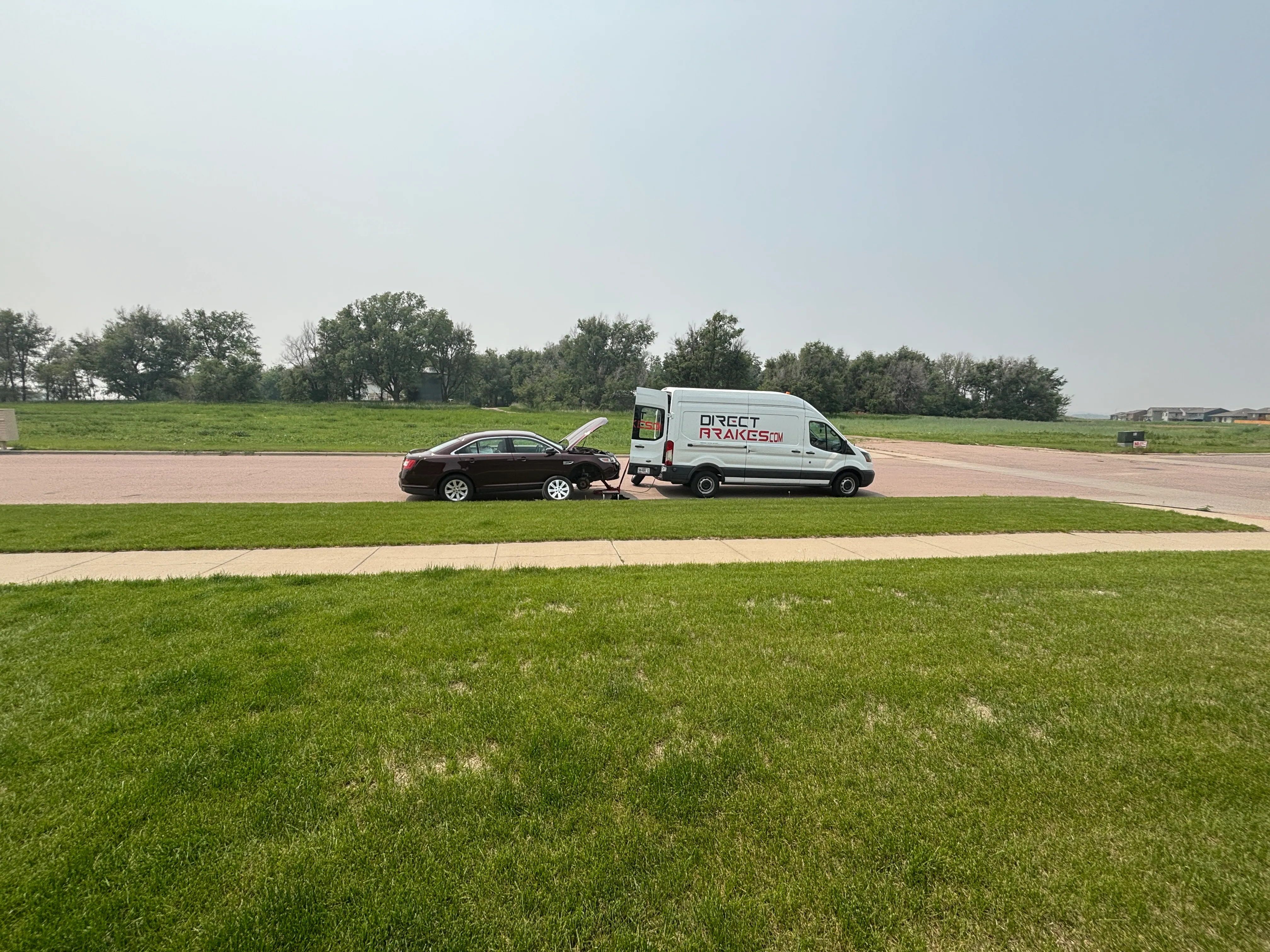
The alternative: mobile brake service comes to wherever you are — home, office, parking lot. The repair takes the same 60–90 minutes, costs the same or less than a shop, and removes all of the risk of driving there. It's the better call in every grinding situation.
4–5 sec following distance
Brake early and gradually
No highway, shortest route
Stop immediately if pedal softens
Same cost or less than a shop
Done in 60–90 minutes
No risk of driving there
Same-day in Sioux Falls & Omaha
Frequently Asked Questions
Car pulling when you brake? Call (605) 376-2130 — we'll diagnose it and fix it at your door, same day.
Grinding brakes? We come to you — same day.
No tow, no driving it in. We fix pads, rotors, and calipers at your home or office in Sioux Falls and Omaha. Done in under 90 minutes.
Get Free Quote (605) 376-2130