
Key Takeaways
- Low-speed brake squeal is caused by stick-slip physics — at slow speeds, the pad and rotor alternately grip and release, creating vibrations in the audible range. High-speed friction is more consistent and doesn't squeal
- Morning squeal that clears in 2–3 stops is surface rust — completely normal, ignore it
- Squeal while coasting that stops when you press the pedal is almost always the wear indicator — book service within 1–2 weeks
- Persistent low-speed squeal during braking that never clears points to shims, slides, pad material, or debris — most are fixable without new pads
- Squeal that turns into grinding has crossed the line — now you need rotors too, adding $150–$250 per axle to the bill
Why low speed specifically — the stick-slip explanation
When you press the brake pedal, the caliper clamps the pad against the spinning rotor. At the microscopic level, the pad surface and rotor surface don't slide smoothly — they grip, flex, release, and grip again thousands of times per second. This is called stick-slip, and the vibration frequency it produces is what you hear as squeal. At high speeds, the rotor surface moves past the pad too quickly for stick-slip oscillations to build into a sustained squeal. At low speeds — under 15 mph, in parking lots, in the last few mph of a stop — the rotor moves slowly enough that stick-slip resonates and the rotor acts like a speaker broadcasting the vibration outward. This is why low-speed squeal is so common and why simply braking harder (more clamping force = more consistent pad contact = less stick-slip) often makes it stop temporarily.
Diagnose It First: The Pattern Guide
Before spending money, identify the pattern. The when of the squeal narrows it down to 1–2 causes almost every time.
Squeal only on the first 2–3 stops of the day, then gone completely
Cause: Surface rust. Iron rotors form a thin oxide layer overnight. First application clears it. No action needed.
Squeal while rolling/coasting that stops the moment you press the brake
Cause: Wear indicator tab contacting the rotor. This is by design — it means pads are at 2–3mm and need replacement. Book service within 1–2 weeks.
Squeal only in wet weather or after rain, clears on dry days
Cause: Moisture on rotor surface amplifying stick-slip. More pronounced with ceramic pads and certain pad compounds. Normal — no action needed unless it persists on dry days too.
Squeal started right after a brake job
Cause: Bedding-in (first 200–400 miles), missing shims, or dry caliper slides from installation. See Cause 5 and 6. Give it 200–400 miles; if still present, call the shop back.
Squeal every time you brake slowly, regardless of temperature or weather
Cause: Worn pads at the indicator, glazed pads, seized caliper slides, missing shims, or debris. Needs inspection. Get it checked within the week.
Squeal turning into grinding or scraping sound
Cause: Pads worn through friction material — metal on metal. Stop driving. Same-day service. Rotors are now being damaged.
Surface Rust — The Most Common, Least Serious Cause
Brake rotors are made of cast iron. Cast iron oxidizes — every time the car sits overnight, in rain, or in high humidity, a thin layer of surface rust develops on the rotor face. This is not structural corrosion. It's a micron-thin oxide film that forms on any exposed iron surface within hours.
When you make your first brake application in the morning, the pad scrubs this layer off the rotor surface. During that scrubbing process, the rough oxide film creates stick-slip vibrations at a different frequency than a clean rotor — you hear a squeal or scrape for the first stop or two, and then it's gone completely for the rest of the day. This is so normal that many owner's manuals specifically address it.
How to confirm it's just rust: the noise appears only on the first 1–3 stops after the car has sat for several hours. It goes away completely and doesn't come back until the next morning (or after the car sits again in rain). Braking performance feels normal. No dust on the wheels beyond the usual. No squeal on subsequent stops.
What to do: nothing. This is not a brake problem. Vehicles parked outdoors, in humid climates, or driven infrequently will show this more than others. If your car sits for several days and the first stop produces a light scrape or single-note squeal followed by a complete cleanup — that's oxidation, not wear.
Only on first 1–3 stops after sitting, then completely gone = surface rust. Not a problem. Not worth an inspection.Wear Indicator Tab — The Squeal That Stops When You Brake
Every modern brake pad has a metal wear indicator — a small spring-steel clip mounted to the pad backing plate. When the friction material wears down to approximately 2–3mm remaining, this clip begins to contact the spinning rotor. The contact point vibrates and produces a chirp or squeal at low speeds and when coasting.
Here's the diagnostic key: this squeal happens while rolling when you're not pressing the brake, and it stops when you press the pedal. The reason: when you press the brake, the caliper clamps the pad firmly against the rotor, pinning the indicator clip and stopping its vibration. When you release the pedal, the clip makes light rotor contact again and the squeal returns.
Some vehicles produce this squeal intermittently at first — only at low speeds, only when turning slightly, only on certain stops. As pads continue to wear, it becomes constant. This is intentional engineering. You have roughly 1,000–3,000 miles of driving left before the indicator progresses to grinding. That's weeks to a few months depending on how much you drive.
What to do: schedule brake service within 1–2 weeks. This is not an emergency — you have time to book rather than panic — but don't ignore it for months. The moment squeal transitions to grinding, rotor damage has begun and your service cost doubles.
Cost at squeal stage: $130–$220 per axle (pads only, if rotors are still thick). Cost at grinding stage: $280–$420 per axle (pads + rotors). The squeal is the cheapest warning you'll ever get.
Squeal while rolling, stops when you press the brake = wear indicator. Service within 1–2 weeks before it turns into a grinding bill.Ceramic Pad Characteristics — Why Material Matters at Low Speed
Not all brake pad compounds behave the same at low speed. The three main types — organic, semi-metallic, and ceramic — have meaningfully different noise profiles, and understanding the difference can save you from a diagnostic dead end.
Organic
Softest. Quietest at low speed. Shortest life (25–40k miles). More dust. Gentlest on rotors.
Semi-Metallic
Mid-range noise. Moderate low-speed squeal. 40–60k miles. Best heat performance.
Ceramic
Hardest. Most prone to low-speed squeal. 50–70k miles. Least dust. Best longevity.
Ceramic pads produce stick-slip vibrations at a higher frequency than softer compounds because they are harder and have less natural damping. Under light pedal pressure at low speeds — exactly the conditions where stick-slip is most active — ceramic pads can produce a sharp, high-pitched squeal that softer pads wouldn't. This is most noticeable when the pads are cold (first 10–15 minutes of driving in cold weather) and in light-braking situations like slow parking lot maneuvers.
Many factory brake packages on performance-oriented vehicles (and increasingly on everyday vehicles) use ceramic or semi-metallic compounds for longevity. If your brakes have always had this light low-speed squeal and your pads are not yet near their wear indicators, pad material is likely the explanation.
What to do: if the pads are in good condition and the squeal only happens in the specific conditions above (cold, light pressure, low speed), this is not a problem. If noise bothers you, switching to an organic compound at next pad replacement will reduce it — but expect more dust and a shorter pad life. For most drivers, learning to live with the occasional low-speed ceramic squeal is the better trade-off.
New Brakes That Squeak — The Bedding-In Window
New brake pads and fresh rotors have perfectly flat, machined surfaces that have never touched each other. Until the pad surface and rotor surface micro-conform to each other — a process called bedding-in — the contact is uneven at the microscopic level. Uneven contact means inconsistent friction, which means stick-slip, which means squeal. This is most pronounced at low speeds and with light brake pressure, exactly when stick-slip conditions are strongest.
The bedding window by pad type:
Organic pads: 100–150 miles. Softer compound conforms quickly. Squeal usually resolves within the first week of normal driving.
Semi-metallic pads: 200–400 miles. Moderate. You'll notice the squeal taper off over 2–3 weeks.
Ceramic pads: 300–500 miles. Hardest compound takes longest to bed. Low-speed squeal in the first month after a brake job with ceramics is almost always bedding, not a defect.
The squeal from new pads is typically highest-pitched and most frequent in the first 50 miles, then progressively less frequent as the surfaces conform. If squeal intensifies or doesn't reduce at all after 400 miles, bedding is not the explanation — check for missing shims or dry caliper slides (see below).
Brand new brakes squeaking at low speed = bedding-in. Normal. Give it 200–500 miles depending on pad type before worrying.Missing or Worn Shims — The Post-Brake-Job Squeal
Brake shims are thin layers of rubber-coated metal or adhesive rubber bonded to the back of the brake pad. Their job is to dampen and absorb the stick-slip vibrations that the pad generates during braking — effectively acting as a vibration isolator between the pad and the caliper piston. When shims are present and in good condition, they absorb enough vibration that the rotor doesn't resonate audibly. When they're missing, worn, or improperly installed, that vibration transfers directly to the caliper and rotor and broadcasts as squeal.
This is one of the most common causes of squeal on a car that was recently serviced. Some budget brake jobs skip new shims or fail to apply fresh damping compound (a high-temperature grease that's applied between the pad backing and shim, not anywhere near the friction surface). The result: a car that squealed before the brake job now squeals louder after it, or a car that didn't squeal before starts squealing from the parking lot.
Related: dry caliper slide pins. The caliper slides on two pins coated with high-temp grease. When that grease dries out or the pins corrode, the caliper can't move freely on the slides — it drags slightly, keeping the pad in partial contact with the rotor even when you're not braking. Constant light contact = constant stick-slip = squeal at low speeds especially. Seized slides are also a cause of uneven pad wear and, eventually, caliper failure.
What to do: if squeal appeared or worsened after a recent brake service, call the shop. Missing shims and dry slides are a workmanship issue on recent work. If it's been more than 6 months since the brake job, this is a normal maintenance item — slides should be cleaned and re-greased at every pad replacement. Cost: typically included in a brake service or $60–$80 as a standalone slide pin service.
Squeal started or got worse right after a brake job = missing shims or dry slides. Call back the shop — this is their fix to make right.Glazed Brake Pads — The Slippery Squeal That Means Less Stopping Power
Brake pad friction material works by generating controlled heat through friction. When pads overheat — from hard repeated stops, prolonged light contact from a stuck caliper, or riding the brakes down a long grade — the organic resins in the pad compound cure and harden on the surface, forming a smooth, glassy layer. This is glazing.
Glazed pads produce a distinctive squeal: consistent, often higher-pitched, and present under moderate-to-light braking at any speed. The more obvious symptom is reduced stopping power — glazed pads have less bite than fresh pads because the hardened surface generates less friction. If your brakes feel like they're not grabbing as well as they used to and you're also getting low-speed squeal, glazing is a strong candidate.
Run your finger along the surface of the brake pad (with the wheel removed). Fresh pad material feels somewhat gritty. A glazed pad surface feels smooth, hard, and almost polished — you may be able to see a shiny zone where the pad contacts the rotor.
The cause behind the cause: glazing from normal heavy braking is one thing. But if pads glaze repeatedly on normal-use vehicles, a partially seized caliper is often the real culprit — the caliper isn't fully releasing after braking, keeping the pad in light contact with the rotor and generating slow heat buildup between stops. Address the caliper or the glazing will return on the new pads.
The fix: replace glazed pads. The rotors should be inspected for a matching glazed band and either resurfaced or replaced. If a caliper was causing the glazing, that needs to be addressed too — otherwise new pads will glaze again within a few thousand miles.
Squealing brakes that also feel less responsive than before = likely glazed pads. Braking performance is compromised. Inspect this week.Debris Caught at the Pad — The Random Squeal With a Simple Fix
A small stone, grit particle, or piece of road debris can work its way between the brake pad and rotor. When it does, it produces a squeal or scrape at low speeds — sometimes consistent, sometimes intermittent depending on where in the rotor rotation the debris is positioned. The sound is often metallic and can appear suddenly, with no prior brake noise history.
The tell: a squeal or scrape that appeared suddenly after driving on a rough road, through gravel, through standing water, or after a car wash. It may be accompanied by a slight vibration on one specific wheel, or the sound may seem to track with wheel rotation (you can sometimes hear the rhythm of it speeding up with wheel speed, then slowing at low speeds). This is more common on vehicles with open-spoke wheels where debris has a direct path to the brake assembly.
In most cases, the debris works its way out on its own after a few stops. If it doesn't clear within a day, it needs to be physically removed — which means removing the wheel, pulling the pad, and cleaning the contact area. Some pebbles get lodged in the dust shield (the thin sheet metal shield behind the rotor) rather than between pad and rotor — same symptom, same fix.
What to do: if it appeared suddenly and you're not near minimum pad thickness, give it a day. If it persists, a quick visual inspection with the wheel off takes minutes. Not a safety concern unless the debris is large enough to compromise pad-to-rotor contact.
All Causes at a Glance — Ranked by Urgency
Frequently Asked Questions
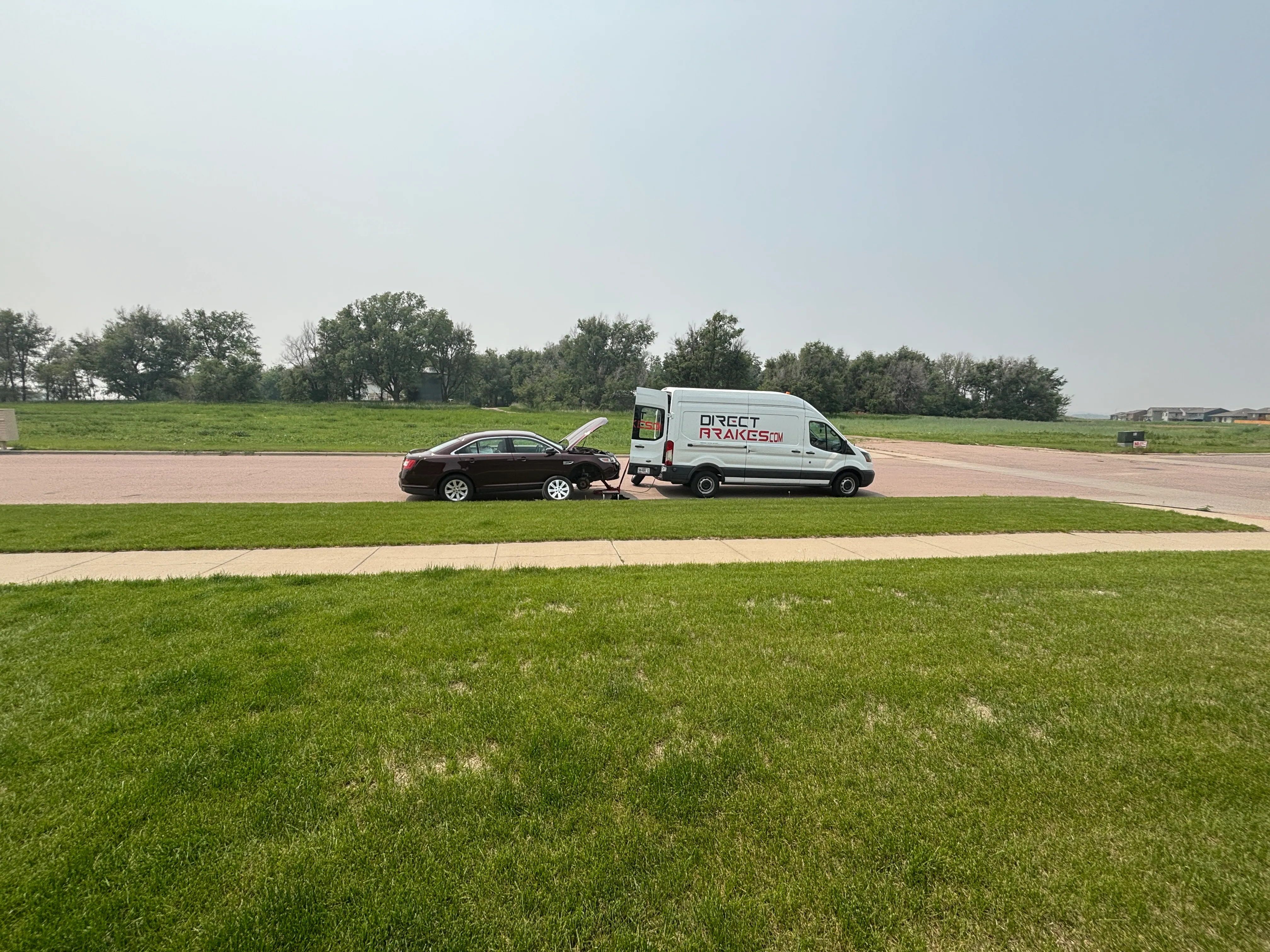
Car pulling when you brake? Call (605) 376-2130 — we'll diagnose it and fix it at your door, same day.
Squeaking brakes? We diagnose at your door.
We find the cause — worn pads, seized slides, missing shims — and fix it same day in Sioux Falls and Omaha. No shop trip.
Get Free Quote (605) 376-2130